


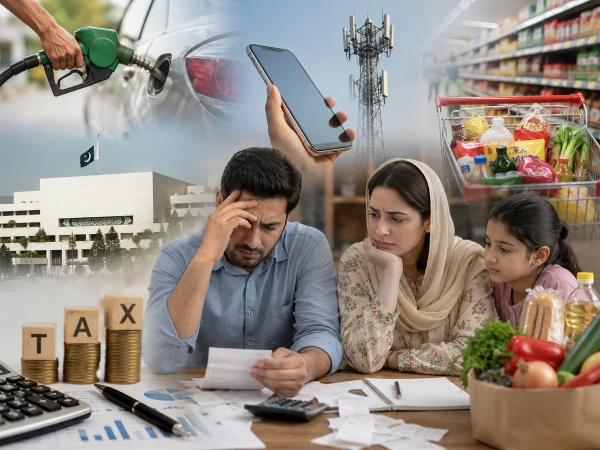
Ahead of the new federal budget, the question is once again being raised as to who pays the highest tax in Pakistan and why the powerful classes living outside the tax net are not being targeted.
Millions of salaried employees across the country pay income tax directly from their monthly income, but despite this, they have to face various indirect taxes in their daily lives.
From buying petrol to using mobile phones and purchasing food items, taxes are collected from the public at almost every stage.
A woman teaching at a private educational institution in Islamabad says that even after tax is deducted from her monthly salary, she pays taxes separately on petrol, mobiles and other essential items, which further shrinks her limited income.
Similarly, people involved in online businesses also blame petroleum levy and other taxes for increasing their financial difficulties.
The government is preparing the budget for the new fiscal year starting July 1. Due to the IMF program and fiscal deficit reduction targets, there are concerns among the public that the burden of additional revenues should not be placed once again on the same classes that are already paying taxes.
According to official data, a large part of tax collections in Pakistan comes from indirect taxes. This is why low-income and high-income earners pay taxes at the same rate in many cases.
Economists say that the most damage from this system falls on the common citizen and the low-income class.
According to financial data, the government collected more than Rs 1,200 billion in petroleum levy during the current fiscal year. A few years ago, this revenue was much less compared to this, however, due to the continuous increase in the levy rate, the collections have increased many times.
According to critics, this has a direct impact on transport, essential goods and overall inflation.
Economists argue that almost every citizen of Pakistan is paying taxes in some form or another, but the real problem is that the tax burden is not distributed evenly. The salaried class becomes an easy target due to being the most documented, while some influential and high-income sectors have still not been fully included in the tax net.
According to FBR data, the salaried class has paid more than Rs 605 billion in income tax in the last fiscal year.
Experts say that this year too, the amount of tax paid by this sector has been more than many large business sectors and the real estate sector.
On the other hand, the agriculture sector, which plays a significant role in Pakistan’s economy, has been a topic of debate for a long time.
Although the country’s large population and a significant part of the economy are associated with agriculture, the tax revenue generated from this sector is said to be very limited.
According to experts, it will be difficult to create a balance in the revenue system without bringing big landowners and some other influential classes into the tax net.
Similarly, a large part of the wholesale and retail business is said to be completely undocumented. The government has tried several times to bring traders into the tax net, but due to various reasons, the desired results could not be achieved.
According to experts, there are thousands of people in the country who have large amounts of money in their bank accounts but their income does not appear in the tax records. If a modern digital system, effective monitoring and a simple tax policy are adopted, the government can significantly increase revenue without imposing new taxes.
Meanwhile, business and industrial circles also have reservations about the current tax structure.
They say that investment and business activities are being affected due to high tax rates, rising energy costs and other financial burdens. To expand the economy, it is necessary to broaden the tax net, and not repeatedly increase the burden on the same people who are already in the system.
Ahead of the budget, ordinary citizens, salaried employees, and business circles have one major expectation that the government, instead of imposing new taxes to increase revenue, should expand the tax net and bring into the fold sectors that have been outside the effective tax system for years.