


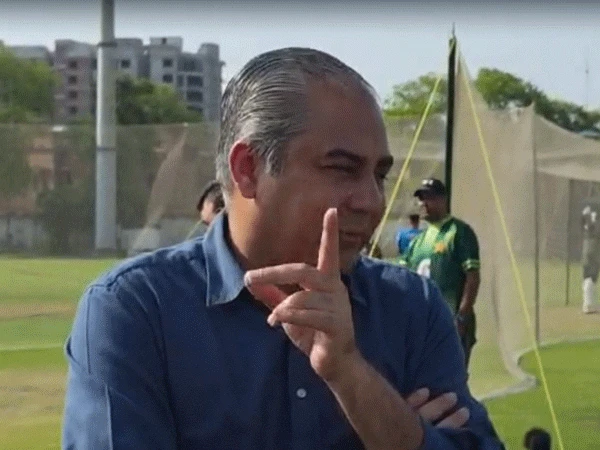
Airman Pakistan Cricket Board and Federal Interior Minister Mohsin Naqvi visited the ongoing Red Ball Camp at the LCCA Ground, where he met the players and coaches and reviewed the training activities.
Director High Performance Aqib Javed, former captains Sarfraz Ahmed and Misbah-ul-Haq, Mike Hesson and other coaches were also present on the occasion.
Talking to the media, Mohsin Naqvi said that work is being completed on new policies for reforms in Pakistan cricket.
He said that separate strategies have been formulated for T20, ODI and Test cricket and the player selection system is being made as computerized as possible to reduce human intervention. He said that about 85 percent of the decisions in the selection process will be based on data, fitness and performance.
The PCB chairman clarified that playing domestic cricket will be mandatory for the central contract and the player who does not meet the prescribed criteria will not get the contract.
He said that five categories are being introduced for the central contract while a special category has also been created for emerging players, which will be given special attention.
Mohsin Naqvi announced that the match fee is being increased in all three formats – Test, ODI and T20, while work is also underway to increase the fees of domestic cricketers. According to him, any player will have to go through the stages of fitness, domestic performance and overall performance to move forward.
He said that all the players have been called for consultation on Monday as they are the key stakeholders in this process. He said that the results of the current reforms will be revealed in one to two years and will help strengthen Pakistan cricket on a long-term basis.
Regarding the Test captaincy, Mohsin Naqvi said that he will not take this decision himself, but the relevant team and selection officials will decide on it.
On the question of Shadab Khan’s possible captaincy, he said that he is not aware of anything definitive in this regard. Regarding Sarfaraz Ahmed, he said that he is an important asset of Pakistan cricket and no final decision has been made regarding his role yet.
Mohsin Naqvi expressed the hope that the new policies will improve the performance of the national team. He said that in the past, some wrong policies and personal interests had harmed Pakistan cricket, but now the institution is being run on a professional basis so that the national team can give better results.
He said that the reason for the poor performances was a flaw in thinking where people were playing cricket for themselves and not for the country.
Mohsin Naqvi said that several demands of Azad Kashmir were accepted by the government, but despite this, the protest attitude continued. According to him, the leadership of Azad Kashmir came up with 28 points, out of which 26 demands were accepted, but still no satisfaction was expressed.
He said that first a concession was obtained on wheat and later protests started on electricity rates. He said that if demands were made in the same manner, the people of other parts of the country may also protest against expensive electricity.
The Interior Minister said that the government would complete its constitutional term and continue to take steps to resolve public problems.
Talking about global oil prices, Mohsin Naqvi said that due to fluctuations in oil prices, there is economic pressure all over the world, however, Pakistan has handled the situation relatively well. According to him, the government ensured fuel supply by utilizing its international relations, which made it possible to avoid an extraordinary increase in the prices of petroleum products.
He said that if timely arrangements were not made, petrol prices were likely to increase by Rs 200 to Rs 250. Mohsin Naqvi said that by the grace of God, Pakistan was safe from this pressure and in the current circumstances, the country’s situation is better than before. He also expressed hope that an agreement between the US and Iran could be reached soon, which is likely to bring stability to global energy markets.