


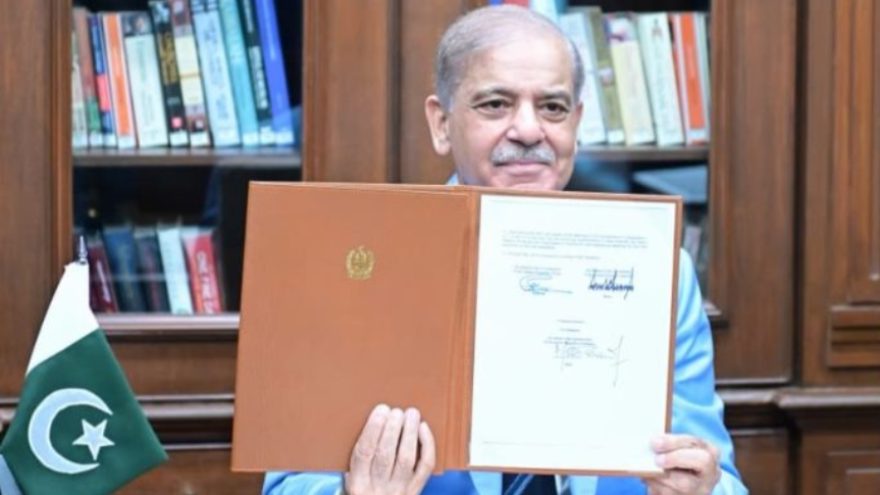
Prime Minister of Pakistan Muhammad Shehbaz Sharif signed the Islamabad Memorandum of Understanding (MoU) as an intermediary.
According to a statement issued by the Prime Minister’s Office, the Islamabad Memorandum of Understanding (MoU) has been signed by US President Donald Trump and Iranian President Masoud Peshmerga.
Prime Minister of Pakistan Muhammad Shehbaz Sharif signed the Islamabad Memorandum of Understanding (MoU) as an intermediary.
The Islamabad Memorandum of Understanding (MoU) has been signed by US President Donald Trump and Iranian President Masoud Peshmerga.@CMShehbaz pic.twitter.com/9bKN6bPWiG
Earlier, Prime Minister of Pakistan Shehbaz Sharif had announced a major diplomatic achievement, saying that the electronic signature of the historic Islamabad Memorandum of Understanding (MoU) between the United States and Iran has been completed. The agreement was signed by the presidents of both countries, while Pakistan ratified it as an intermediary.
Shehbaz Sharif said in his statement on X that this agreement reached at the highest government level has given clear evidence that Washington and Tehran agree to take a diplomatic path to resolve the dispute. The Memorandum of Understanding has come into effect immediately.
I am honoured to announce that the historic ‘Islamabad Memorandum of Understanding’ has been electronically signed today between the United States of America and the Islamic Republic of Iran. The Memorandum has been signed by honourable Presidents of both the countries and also…
— Shehbaz Sharif (@CMShehbaz) June 17, 2026
He said that under the agreement, in the first phase, Iran will immediately open the Strait of Hormuz for maritime traffic, while the United States will immediately end its naval blockade.
Prime Minister Shehbaz Sharif said that Pakistan, in cooperation with the co-mediator State of Qatar, will host a formal ceremony to commemorate this historic development in Switzerland on June 19, 2026, where technical-level talks between the two countries are also expected to begin.
On this occasion, Shehbaz Sharif paid tribute to US President Donald Trump, saying that his commitment to diplomacy and policy of prioritizing peaceful resolution of disputes made it possible to end a crisis that could have had disastrous consequences for the entire region and the world.
The Prime Minister also appreciated the services of members of the US negotiating team, JD Vance, Steve Witkoff and Jared Kushner, who played a significant role in finalizing the agreement.
Shehbaz Sharif paid tribute to the Iranian leadership, praising the vision, foresight and commitment to peace of Supreme Leader Ayatollah Seyyed Mojtaba Hosseini Khomeini and Iranian President Masoud Peshmerga.
The Prime Minister also called the efforts of Iranian negotiating team members Mohammad Baqir Qalibaf, Abbas Araqchi and Eskandar Momini key to the success of the agreement.
In the statement, Shehbaz Sharif particularly appreciated the constructive engagement and diplomatic cooperation of the Qatari leadership, while the role of the leadership of Saudi Arabia, Turkey and Egypt was also described as indispensable and extremely important.
Prime Minister Shehbaz Sharif specifically mentioned Field Marshal Asim Munir and said that his tireless efforts, selfless commitment and behind-the-scenes diplomatic role proved decisive in making this progress possible and promoting peace and stability in the region.
Shehbaz Sharif expressed the hope that the Islamabad MoU would prove to be a strong and lasting foundation for better mutual understanding, respect, trust and shared prosperity in the region and would open new doors for peace and cooperation in the future.
US-Iran MoU signing welcomed, congratulates US and Iranian leadership
President Asif Ali Zardari warmly welcomed the “Islamabad MoU” signed between the US and Iran, calling it a historic moment for the region and the world.
In a message, the President said that the conflict that began in February 2026 had caused immense hardship to the people of the region and severely affected global energy supply, trade and economic stability.
He expressed hope that such a tragic situation would not recur and that the countries of the region would devote their energies to development, prosperity and public welfare.
The President paid tribute to Prime Minister Muhammad Shehbaz Sharif, Deputy Prime Minister and Foreign Minister Senator Muhammad Ishaq Dar, Field Marshal Syed Asim Munir and Federal Interior Minister Mohsin Naqvi, saying that their tireless diplomatic efforts played a significant role in bringing the parties to an agreement.
President Asif Ali Zardari said that Pakistan played a principled, balanced and constructive role throughout the crisis and maintained contact with all relevant parties, supporting continuous dialogue, restraint and peaceful resolution of disputes.
He also praised the leadership of US President Donald Trump, Iranian Supreme Leader Ayatollah Seyyed Mojtaba Hosseini Khamenei, President Masoud Pezizkian and Foreign Minister Abbas Araqchi and said that both sides played an important role in ensuring a diplomatic resolution of the dispute and the promotion of peace.
The President also appreciated the valuable support of brotherly countries Qatar, Saudi Arabia, Turkey and Egypt, as well as Russia and China, saying that their efforts and encouragement of the negotiation process helped in achieving peace.
Asif Ali Zardari urged all parties to ensure full implementation of the Islamabad Memorandum of Understanding and intensify efforts to reach a final agreement within the stipulated time frame so as to pave the way for lasting peace and development.
“Heroes are those who end wars, not those who want to start them,” he said. The President expressed hope that this MoU, which bears the hallmark of Pakistani mediation, will prove to be the foundation of lasting and comprehensive peace in the region and will provide an opportunity for countries to focus on economic development, energy cooperation and the welfare and development of their people.
He added, “War brings nothing but destruction and misery. Peace is the only path to development. Pakistan will stand in solidarity with all brotherly countries in the region in a common journey of peace and prosperity.”
Earlier, US President Donald Trump and Iranian President Masoud Peshmerga signed a 14-point MoU.
Iranian Foreign Ministry Spokesperson Esmail Baqai told the media that the US and Iranian presidents electronically signed the text of the MoU, after which the agreement came into effect.
He said that a fee would be charged for the services provided to ships passing through the Strait of Hormuz. Iran has the option to reduce its enriched uranium to low levels, but Iranian nuclear material will not be sent out of the country.
According to Esmail Baghai, no party will be allowed to increase its military presence in the region or impose new sanctions during the next 60 days. He said that the oil sanctions on Iran should be lifted and Iran should be allowed to continue its oil exports immediately.
The spokesman said that the United States will be obliged to remove obstacles to access to Iran’s frozen assets, while Iran will not negotiate with any party about its defense capabilities.
Meanwhile, about an hour after US President Donald Trump and Iranian President Masoud Pezishkian confirmed the signing of the memorandum of understanding, the White House released a video of President Trump signing it.
The United States has also released the official text of the memorandum of understanding reached with Iran. The agreement has been titled the “Islamabad Memorandum of Understanding”.
According to CNN World, a senior US administration official described the 14-point document, saying it includes reopening the Strait of Hormuz, easing some financial sanctions on Iran, and setting out expectations regarding Iran’s nuclear program during future technical talks.
According to the senior US official, the agreement provides a framework for the immediate reopening of the Strait of Hormuz, steps related to Iran’s nuclear materials, and a phased easing of sanctions, which could lead to an improvement in Iran’s economic situation.