Daily The Patriot

Trump insists on declaring the Strait of Hormuz a 'new American territory'; makes a big claim

Link copied!

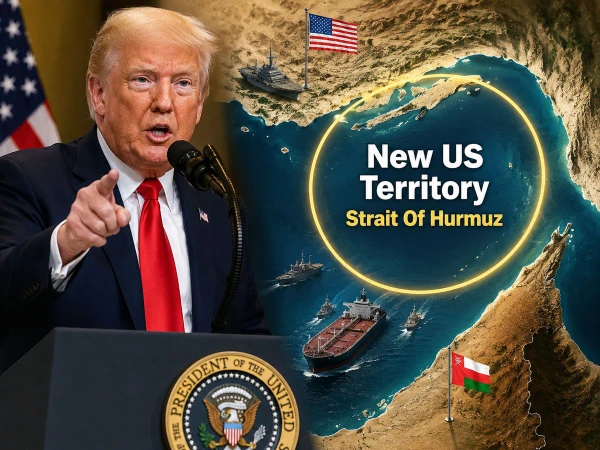
US President Donald Trump has once again shared a map of the Strait of Hormuz on social media, declaring it a new American territory.

US President Donald Trump posted a map of the Strait of Hormuz on his social media platform Truth Social, in which a circle was drawn around this important waterway between Iran and Oman and the words “new American territory” were written on it. Strait of Hormuz

President Trump did not write any caption with this photo, but sharing the photo in which the Strait of Hormuz is written as American territory proves what the US President’s intentions are.

It should be remembered that US President Donald Trump had supported the plan to declare the Strait of Hormuz as American territory a day earlier, saying that it was a “great idea”.

When reporters asked Trump last week what he meant by declaring the Strait of Hormuz as American territory, the US President replied that I mean we control it. Strait of Hormuz

He added that the US controls the Strait of Hormuz due to Iran’s naval blockade and that he likes the idea of ​​declaring the Strait of Hormuz as US territory.

President Trump also said on Friday that he intends to declare the Strait of Hormuz as US territory after the US defeats Iran.

Who controls the Strait of Hormuz?

Trump has repeatedly claimed that the US “owns” the Strait of Hormuz, but according to experts, the reality is completely different and much more complex.

The Strait of Hormuz is a major waterway connecting the Persian Gulf and the Gulf of Oman, approximately 50 km wide, with Iran in the northern part and Oman in the southern part. Some parts of it fall within the territorial waters of Iran and Oman. Strait of Hormuz

Experts say that neither Iran nor the US can claim absolute legal ownership of the entire waterway, while ships have the right of passage under international maritime law.

A presidential decree alone cannot make a territory American

Jason, a professor at City, University of London and an expert in maritime law, said that it would not be enough for the US president to simply declare an area as US territory through a declaration or order.

According to him, under US law, constitutional requirements must be met to make a new territory part of the country, while under international law, unilaterally annexing a territory is contrary to the UN Charter.

Professor Jason Chuah further said that in order to legally acquire a territory or sea area, the consent of the relevant state or the formal transfer of that territory would be necessary.

Simon Baughan, a professor of shipping law at Swansea University, also said that in order to make the Strait of Hormuz a US territory, Iran would have to agree to hand over its territorial waters to the US, which is highly unlikely under the current circumstances.

Military control is not proof of ownership

Experts also rejected Trump’s position that controlling the Strait of Hormuz proves US ownership of it.

In this regard, Jason Chuah said that gaining military control over a sea route does not transfer legal ownership of the area.

He clarified that the navy can control a waterway, but it cannot change the law of ownership through control alone.

According to him, the Strait of Hormuz is neither Iranian territory nor Omani property in the traditional sense, but it is a waterway under the international maritime system where the principles of freedom of navigation apply. Strait of Hormuz

The proposal to charge a toll could also become a legal dispute

Similarly, another expert, Professor Simon Baughan, said that instead of making the Strait of Hormuz a US territory, a more likely scenario could be for the US, Iran and Oman to agree to open the strait through an agreement and collect a fee or toll from ships passing through it.

However, according to him, such an arrangement could also conflict with traditional international maritime law and the 1982 United Nations Convention on the Law of the Sea (UNCLOS).

It should be noted that the Strait of Hormuz is one of the world’s most important energy corridors and connects the oil-producing countries of the Persian Gulf to global markets. Therefore, the situation in this waterway during the ongoing US-Iran tensions in the region has also affected the global energy market.

Leave a Reply

Your email address will not be published. Required fields are marked *

Trump insists on declaring the Strait of Hormuz a 'new American territory'; makes a big claim

Link copied!

US President Donald Trump has once again shared a map of the Strait of Hormuz on social media, declaring it a new American territory.

US President Donald Trump posted a map of the Strait of Hormuz on his social media platform Truth Social, in which a circle was drawn around this important waterway between Iran and Oman and the words “new American territory” were written on it. Strait of Hormuz

President Trump did not write any caption with this photo, but sharing the photo in which the Strait of Hormuz is written as American territory proves what the US President’s intentions are.

It should be remembered that US President Donald Trump had supported the plan to declare the Strait of Hormuz as American territory a day earlier, saying that it was a “great idea”.

When reporters asked Trump last week what he meant by declaring the Strait of Hormuz as American territory, the US President replied that I mean we control it. Strait of Hormuz

He added that the US controls the Strait of Hormuz due to Iran’s naval blockade and that he likes the idea of ​​declaring the Strait of Hormuz as US territory.

President Trump also said on Friday that he intends to declare the Strait of Hormuz as US territory after the US defeats Iran.

Who controls the Strait of Hormuz?

Trump has repeatedly claimed that the US “owns” the Strait of Hormuz, but according to experts, the reality is completely different and much more complex.

The Strait of Hormuz is a major waterway connecting the Persian Gulf and the Gulf of Oman, approximately 50 km wide, with Iran in the northern part and Oman in the southern part. Some parts of it fall within the territorial waters of Iran and Oman. Strait of Hormuz

Experts say that neither Iran nor the US can claim absolute legal ownership of the entire waterway, while ships have the right of passage under international maritime law.

A presidential decree alone cannot make a territory American

Jason, a professor at City, University of London and an expert in maritime law, said that it would not be enough for the US president to simply declare an area as US territory through a declaration or order.

According to him, under US law, constitutional requirements must be met to make a new territory part of the country, while under international law, unilaterally annexing a territory is contrary to the UN Charter.

Professor Jason Chuah further said that in order to legally acquire a territory or sea area, the consent of the relevant state or the formal transfer of that territory would be necessary.

Simon Baughan, a professor of shipping law at Swansea University, also said that in order to make the Strait of Hormuz a US territory, Iran would have to agree to hand over its territorial waters to the US, which is highly unlikely under the current circumstances.

Military control is not proof of ownership

Experts also rejected Trump’s position that controlling the Strait of Hormuz proves US ownership of it.

In this regard, Jason Chuah said that gaining military control over a sea route does not transfer legal ownership of the area.

He clarified that the navy can control a waterway, but it cannot change the law of ownership through control alone.

According to him, the Strait of Hormuz is neither Iranian territory nor Omani property in the traditional sense, but it is a waterway under the international maritime system where the principles of freedom of navigation apply. Strait of Hormuz

The proposal to charge a toll could also become a legal dispute

Similarly, another expert, Professor Simon Baughan, said that instead of making the Strait of Hormuz a US territory, a more likely scenario could be for the US, Iran and Oman to agree to open the strait through an agreement and collect a fee or toll from ships passing through it.

However, according to him, such an arrangement could also conflict with traditional international maritime law and the 1982 United Nations Convention on the Law of the Sea (UNCLOS).

It should be noted that the Strait of Hormuz is one of the world’s most important energy corridors and connects the oil-producing countries of the Persian Gulf to global markets. Therefore, the situation in this waterway during the ongoing US-Iran tensions in the region has also affected the global energy market.

Leave a Reply

Your email address will not be published. Required fields are marked *