


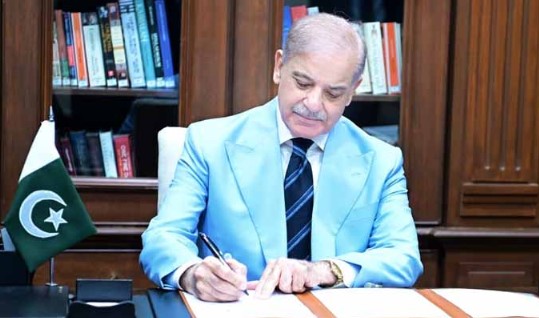
ISLAMABAD: The Prime Minister of Pakistan, Muhammad Shehbaz Sharif, has signed the Memorandum of Understanding (MoU) electronically today with the United States and Iran, in his role as mediator.
He said that the agreement was signed by US President Donald J. Trump and Iranian President Masoud Pezeshkian. The MoU reflects a diplomatic effort aimed at easing tensions between the two countries through negotiated settlement.
According to PM Sharif, the development marks a step towards de-escalation, with both sides agreeing to move forward under the framework outlined in the memorandum.
Trump, Pezeshkian sign the agreement
Earlier today, the agreement facilitated by Pakistan at came into force today after both countries’ presidents electronically signed the accord, marking a significant diplomatic breakthrough for Islamabad.
PM Sharif announced that the “Islamabad Memorandum of Understanding” had been signed by US President Donald Trump and Iranian President Masoud Pezeshkian, with Pakistan acting as mediator. He said the agreement had taken effect immediately and included an initial phase in which Iran would reopen the Strait of Hormuz while the United States would lift its naval blockade.
PM Sharif described the development as evidence of both sides’ willingness to pursue a negotiated settlement. He also acknowledged the role of international and regional stakeholders, thanking the negotiating teams from Washington and Tehran as well as mediators and partners including Qatar, Saudi Arabia, Türkiye and Egypt. He separately highlighted the contribution of Pakistan’s military leadership, saying Field Marshal Syed Asim Munir played a key role in facilitating the outcome.
Trump, speaking on the sidelines of the G7 summit in France, confirmed the agreement but warned that Washington could resume military action if Iran failed to comply. “If they violate the agreement, we’ll strike again,” he said, while expressing hope the deal would lead to broader stability in the Middle East.
Iranian officials welcomed the implementation of the accord. Chief negotiator Mohammad Baqer Ghalibaf said Tehran had achieved through diplomacy outcomes that could not be secured through war, while Iranian authorities confirmed the ceasefire framework had entered into force immediately after signing.
The 14-point memorandum extends an earlier ceasefire by 60 days, creating a window for negotiations on a long-term settlement. It includes a halt to hostilities across multiple fronts, reopening of key maritime routes, easing of US sanctions, release of frozen Iranian assets and a reconstruction and investment mechanism for Iran.
However, several core disputes remain unresolved, including Iran’s missile programme and its support for regional armed groups. Trump reiterated that the United States remained prepared to use force if necessary, while Iranian officials maintained that their strategic defence capabilities were unchanged.
Global markets reacted positively, with oil prices falling on expectations of improved supply flows through the Strait of Hormuz. G7 leaders welcomed the agreement but also urged a ceasefire in Lebanon, where fighting has continued despite the broader deal.
Israeli strikes and reported drone attacks continued in southern Lebanon, underscoring the fragility of the regional situation. Israel, which was not part of the negotiations, said it retained the right to continue operations against Hezbollah.
While an additional signing ceremony in Switzerland had been previously suggested, Iranian officials said it would not take place, citing completion of the electronic signing process.
The coming weeks are expected to focus on detailed negotiations over sanctions relief, nuclear verification mechanisms and a permanent peace framework, with Pakistan continuing its diplomatic engagement in the process.