


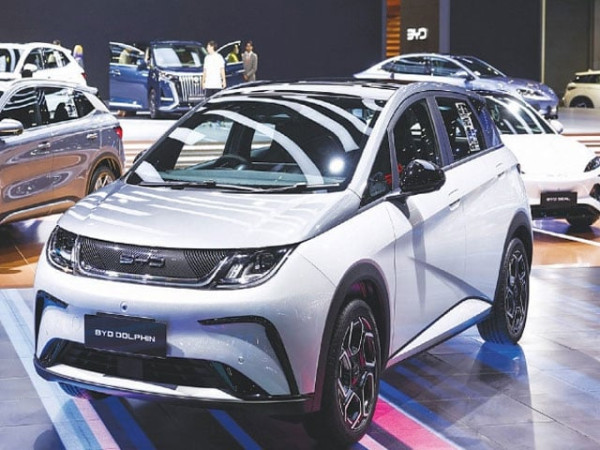
The federal government has submitted a tax revenue alternative plan to the International Monetary Fund (IMF) to maintain a one percent concessional sales tax rate on electric vehicles in the new auto policy. If approved by the IMF, the new auto policy will be issued after approval from the federal cabinet.
Sources say that the IMF had demanded an increase in sales tax on electric vehicles from one percent to 18 percent.
The government wants to maintain the one percent concessional sales tax rate to promote electric vehicles and the government team had assured the IMF of collecting additional revenue from alternative sources.
Sources say that the government has submitted the draft of the new auto policy approved by the Prime Minister along with the tax revenue alternative plan to the IMF, which has opened the possibility of getting sales tax relief of Rs 85 billion in the form of concessional sales tax for electric vehicles.
Sources say that under the alternative plan for tax revenue, a proposal to increase the sales tax to one percent on electric vehicles worth up to $75,000 is under consideration.
The proposed auto policy also includes a proposal to impose an automotive development levy on petrol and other vehicles.
A two percent levy can be imposed on vehicles up to 1,010cc and 2,000cc, while a 10 percent levy can be imposed on vehicles of 2,010cc or more. This will apply to locally manufactured and imported petrol engine vehicles.
According to sources, a proposal to impose a 10 percent federal excise duty on electric vehicles worth more than Rs20 million is also under consideration. Under the new policy, the carbon levy on petrol, diesel and other vehicles is also likely to remain.
Under the proposed measures, it is expected to generate Rs25 billion from the carbon levy on petrol and diesel vehicles, while Rs37 billion from the total levy.
Similarly, it is estimated that Rs45 billion will be collected from buses and trucks through the Automotive Development Levy. According to sources, amendments can also be made to the Finance Bill to finalize these proposals, however, the final decision on all measures will be taken after the approval of the IMF.