Daily The Patriot

New peace agreement between world powers

Link copied!

There are moments on the horizon of world politics whose significance is not limited to a diplomatic meeting, a joint declaration, or a few happy sentences, but rather have the potential to determine the direction of the coming era.

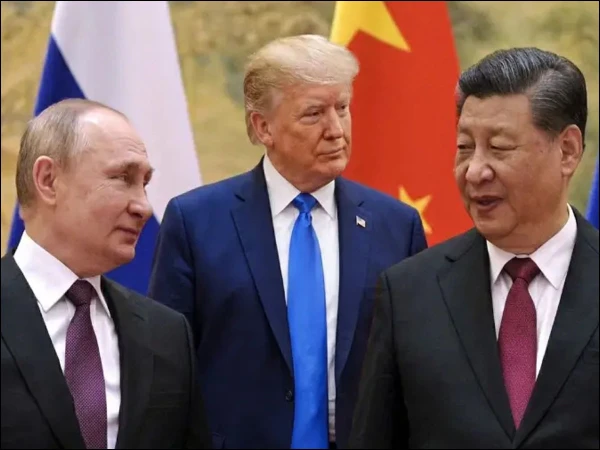
The gathering of the leadership of Washington, Moscow, and Beijing around a table and acknowledging the unthinkable consequences of nuclear war and expressing a common resolve to oppose it is also an extraordinary event. The historic trilateral meeting of President Donald Trump, President Vladimir Putin, and President Xi Jinping has once again highlighted the fact that the prospects for world peace can be revived if the world’s greatest military, economic, and nuclear powers are willing to submit their mutual differences to negotiations.

However, the real test of this progress will not be the words of the declaration but their practical results, for history is witness that the more hopes great agreements between great powers create, the greater the global trials that arise from their departure.

In a joint statement issued after the meeting, which lasted about an hour and a half, the three leaders reaffirmed the principle that nuclear war should never be fought and that negotiations must continue to prevent nuclear proliferation. This is a principle that seems indisputable, but its significance is extraordinary because in the current global environment, distrust, military competition and strategic tension between nuclear-capable states have reached dangerous levels.

The war in Ukraine, the uncertain situation in the Middle East, the growing defense alignment in the Asia-Pacific and the struggle for power in different regions have constantly put global security under pressure. In such circumstances, the joint rejection of war by the three major nuclear powers provides an important opportunity for diplomacy. The real significance of this meeting lies in the fact that the United States, Russia and China are not just three sovereign states, but are centers that have a decisive influence on the formation of the current world order and its future. The financial, military, and technological superiority of the United States, the industrial power and economic expansion of China, and the nuclear capability and geostrategic importance of Russia, give these three countries a unique position in world affairs. The differences between them are not limited to any one region, but their effects reach global markets, energy supplies, defense spending, trade routes, and the foreign policies of small states.

Therefore, direct dialogue between these powers can be a means of reducing global tensions, provided that this contact takes the form of a permanent diplomatic strategy rather than a temporary political necessity. President Trump’s statement that peace in the world is not possible without negotiations is a reminder of a fundamental truth. The importance of force in international relations is undeniable, but the sustainable use of force is possible only when it is guided by political insight and diplomatic prudence. Military superiority alone cannot provide lasting security to a state. There are numerous examples in history when states with extraordinary military power failed to achieve their goals due to political mistakes, unnecessary wars, and diplomatic isolation. This reality is even more acute in the age of nuclear weapons, because in conventional warfare there is a concept of victory or defeat, but in a nuclear conflict the distinction between victor and vanquished can be buried under the rubble of human destruction.

President Putin’s accusation that Ukraine and the EU are not ready to compromise also highlights a significant complexity facing this meeting. The conflict in Ukraine is no longer just a border or territorial dispute between Russia and Ukraine; it has pitted the entire European security architecture, NATO strategy, American influence, and Russia’s territorial interests against each other. It will not be enough to simply accept the position of one side. A lasting settlement must be based on sovereignty, legitimate security concerns, and respect for international law. If the trilateral dialogue leads to an effective confidence-building process between Washington and Moscow, it could pave the way for an end to the war in Europe and a reduction in the strain on the global economy.

However, ignoring Ukraine and European countries and making decisions about their future cannot guarantee any lasting peace. Chinese President Xi Jinping’s emphasis on the joint role of the three countries in addressing global challenges clarifies the broader context of this meeting. China wants a global system in which economic cooperation, trade relations and multilateral diplomacy are given greater importance. On the other hand, trade competition between the United States and China, control over modern technology, and issues of influence in the Taiwan and Pacific regions continue to be causes of differences. Despite these disputes, creating space for cooperation based on common interests is a mature vision of world politics.

If these three states succeed in preventing economic competition from turning into military conflict, its effects will be felt all over the world. The agreement on energy security and increasing the production and supply of refined petroleum products is an aspect of this meeting whose effects can directly reach the global economy and ordinary consumers. Energy is not just a source of industrial development, but also the basis of national security, food security, transportation, and economic stability. Uncertainty in the global oil and gas market, geopolitical conflicts, and access

Diplomatic statements alone will not suffice for this, but domestic economic reforms, increased industrial capacity, alternative energy sources, policy continuity and restoration of investor confidence are essential. Improved relations between world powers can create opportunities for Pakistan, but the responsibility to convert these opportunities into national development rests with our own leadership and institutions. A fundamental question in the context of this tripartite meeting is whether the world is truly ready to move from a clash of power to an era of cooperation. This cannot be answered by a mere declaration.

Only adherence to nuclear non-proliferation treaties, a responsible balance in military spending, political resolution of regional disputes and impartial functioning of international institutions can make this commitment credible. The three leaders must prove to their respective allies, rivals and the international community that the concept of peace is a permanent part of their diplomatic strategy, and not an expression of a temporary political need. Instead of a new global hegemony, the world needs a balanced system in which differences are not used as justification for war, power is not considered above the law, and the sovereignty of small states is not sacrificed to the interests of large powers. This meeting between Washington, Moscow, and Beijing is a possible step in this direction.

If the three countries succeed in translating their joint declaration into practical measures, continuous dialogue, and mutual trust, this meeting will be remembered in history not as a mere diplomatic image but as an important milestone in the formation of world peace. Otherwise, it will also join the many declarations of world politics whose words are preserved in history, but their promises are lost somewhere in the practical world.

Leave a Reply

Your email address will not be published. Required fields are marked *