


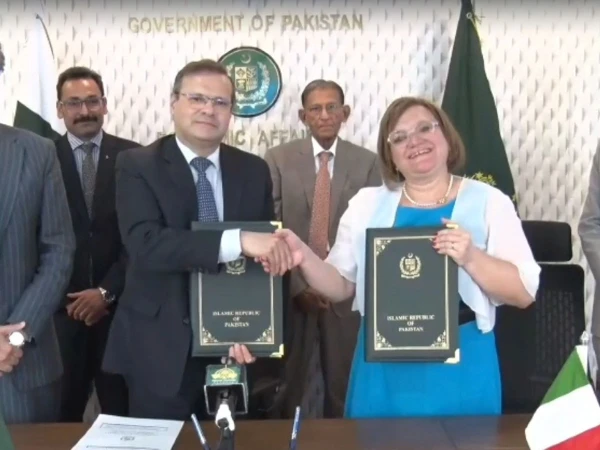
Islamabad: A concessional loan agreement of 20 million euros (Rs 6.3 billion) has been signed between Pakistan and Italy.
According to Secretary of the Ministry of Economic Affairs Muhammad Hamir Karim and Italian Ambassador Marilena Armelin signed the agreement. Under the project, Pakistan’s technical and vocational education and training system will be strengthened in the agricultural sector.
According to the Ministry of Economic Affairs, the capacity of farmers and extension staff will be enhanced through modern and market-oriented training programs. The program aims to increase agricultural production, sustainable agricultural practices and improve the economic conditions of the rural people.
According to the spokesperson, the development of high-value agricultural crops and strengthening agro-food value chains will be promoted. Special training centers will be established for those involved in horticultural production, processing and marketing. Under the project, special attention will be paid to crops such as olives, pistachios, dates, mushrooms, cherries, grapes, peaches and almonds.
According to the ministry spokesperson, the modern Italian agricultural expertise and Pakistan’s vast agricultural potential will be utilized. A total of 720 training courses will be organized during this 42-month program. 18,398 people will benefit from these training courses. 11 standard training curricula will also be developed for the agriculture sector under the project.
According to the Ministry of Economic Affairs, 12 model gardens and nurseries will be established, 8 eco-friendly villages compatible with climate change will be created, 5 agricultural and food processing units and 2 national centers of excellence will be established, national centers of excellence will be established for the production of cano and malta in Sargodha and for date palm in Turbat. The Pakistan Oilseed Department will implement this project in collaboration with the provincial agriculture department.
According to the spokesperson, the project will create new employment opportunities in rural areas, increase the income of farmers, and reduce post-harvest losses due to the program.