


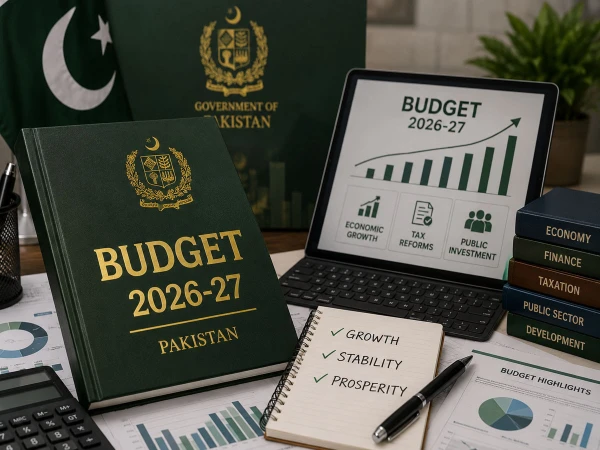
The federal government will present a federal budget of more than Rs 17.5 trillion for the upcoming fiscal year 2026-27 tomorrow. The budget is likely to provide relief of up to Rs 50 billion in the form of increase in salaries and pensions of government employees and reduction in tax rates, while the tax revenue target for providing tax relief is expected to be Rs 15,267 billion.
According to the report, the draft federal budget for the upcoming fiscal year 2026-27 and the increase in salaries and pensions of government employees will be approved in a special meeting of the federal cabinet chaired by Prime Minister Mian Shahbaz Sharif tomorrow.
Immediately after the approval of the federal cabinet, Federal Finance Minister Muhammad Aurangzeb will present the federal budget for the next fiscal year in Parliament.
According to sources, it has been decided not to make any changes in the taxes imposed on solar panels, stationary items and the stock market in the federal budget.
According to sources, the proposal to increase the sales tax rate on solar panels from 10 percent to 18 percent has been withdrawn, while the proposed proposal to increase the sales tax on stationary items will also not be part of the budget. The budget is likely to increase the sales tax rate on imported electric vehicles (EVs) to 25 percent, while the current tax rates on hybrid vehicles are likely to remain.
The budget is likely to provide tax relief for eco-friendly electric vehicles, while a carbon levy is proposed for vehicles running on conventional fuels. There is a fear that large vehicles will become more expensive, while locally manufactured electric vehicles are expected to be cheaper, however, the usual taxes on hybrid vehicles will remain.
It is proposed to reduce the customs duty on motors, batteries and other parts for the local manufacture of electric vehicles to one percent.
Sales tax is also recommended to be kept at one percent, while complete exemption of federal excise, capital value and withholding tax has been proposed. According to sources, the plan is to collect Rs 1,727 billion from petroleum levy in the new budget.
It has been proposed to keep Rs 7,824 billion for interest on loans. The defense sector is proposed to keep about Rs 3,000 billion. The trade deficit is expected to exceed $ 37 billion in the next fiscal year because the export target has been set at $ 32.8 billion, while imports are estimated at $ 70 billion.
The target for agricultural growth has been set at 3.8 percent. Industries will grow at a rate of 4 percent, while the growth target for large industries is 4.5 percent, while the performance of services is estimated to be 4.2 percent. The government is committed to creating 2 million new employment opportunities.
A target of 1.1 million jobs has been set in the services sector, 500,000 in the industrial sector and 400,000 in the agricultural sector. The National Economic Council has also approved key economic targets for the upcoming federal budget.
A national development plan of Rs 3,669 billion has also been approved by the NEC. The volume of the federal PSDP is Rs 1,000 billion.
Rs 2,218 billion has been set aside for the development projects of the four provinces. The federation and the provinces will jointly save Rs 1,046 billion in the development budget.
Punjab’s development budget was cut by Rs 701 billion, Sindh’s by Rs 110 billion and Khyber Pakhtunkhwa’s funds by Rs 109 billion. It was decided that no new development projects will be launched except for the Ministry of Defense and the Ministry of Interior.
The federal government is considering giving tax relief of about Rs 50 billion to the salaried class in the new fiscal year budget. The number of income tax slabs can be increased from 6 to 8. According to sources, relief is being considered for people with an income of more than Rs 183,000 per month.
There are also proposals to relax the tax rate for those with high incomes. Under the proposed plan, a 5% reduction in income tax is proposed on monthly income of Rs 267,000, after which the tax rate in this slab can be reduced from 25% to 20%. About 400,000 employees are likely to benefit from this slab.
Sources say that a proposal to impose a 29 percent tax on income up to Rs 467,000 per month, while a 32 percent tax rate on income up to Rs 583,000 is also under consideration, while a maximum tax of 35 percent is likely to be maintained on monthly income above Rs 583,000.
The same rate is proposed to be imposed on those earning more than Rs 7 million per year, while the surcharge imposed on those earning more than Rs 10 million per year may be abolished.
According to sources, in the upcoming federal budget for the fiscal year 2026-27, capital gains tax is likely to be imposed on profits earned from crypto trading to bring crypto transactions into the tax net.
The budget is also likely to end tax exemption for former tribal areas. It is also likely to include dozens of food items including baby formula, milk, ghee, cooking oil in the third schedule of sales tax, under which it is proposed to make it mandatory to print the retail price on the packaging of these items.
Sources say that the new budget also proposes to impose new taxes worth Rs 220 billion. The federal budget for the next fiscal year 2026-27 is likely to set a target of generating additional revenue of Rs 1,000 billion through new tax measures and enforcement. The budget also proposes to impose federal excise duty on naphtha petroleum products. It has also decided to introduce a fixed sales tax system for the steel sector and strict penalties for taxpayers who do not implement digital integration, production monitoring and point-of-sale (POS) systems by making major amendments to the tax laws.