


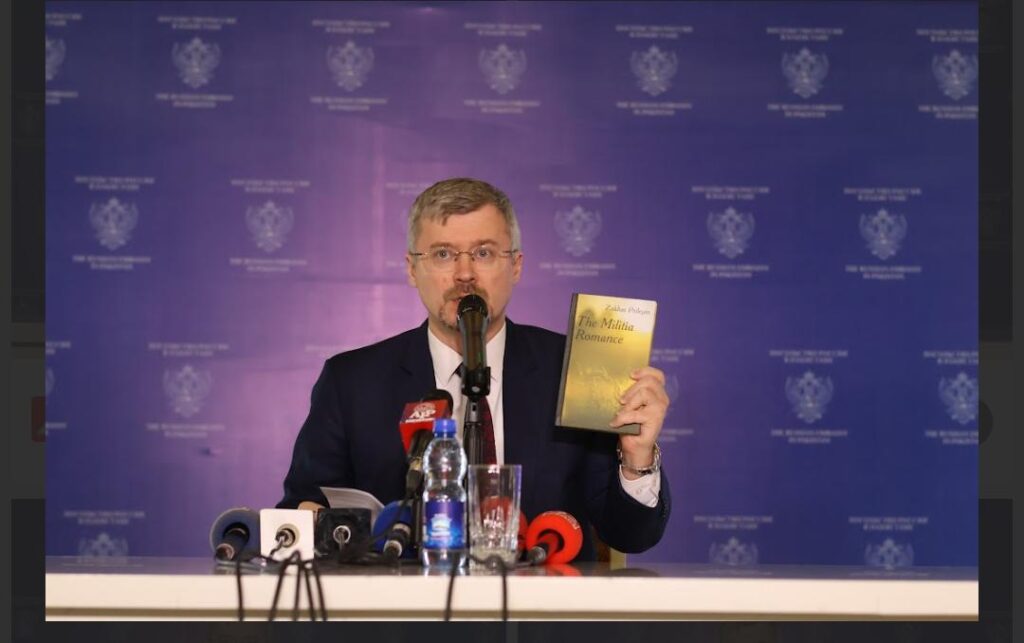
On May 19, Ambassador Albert Khorev held a briefing on the situation in and around Ukraine. The event was attended by representatives of the Pakistani media and academic community.
At the outset, the Ambassador highlighted Russia’s international efforts to combat the glorification of Nazism, referring in particular to the thematic resolution annually adopted by the United Nations General Assembly with Pakistan’s consistent support.
Ambassador Khorev also underscored Russia’s peace initiatives in the context of the Ukrainian conflict, noting that the Kiev regime, backed by Western countries, continues to prolong hostilities. Particular attention was paid to the issue of forced mobilization in Ukraine, as well as to the growing Ukrainian corruption scandals involving members of Zelenskyy’s inner circle.
The Ambassador drew attention to the deteriorating crime situation in Ukraine and strongly condemned attacks on civilian and energy infrastructure, including the “TurkStream” and “Blue Stream” pipelines, stressing that such actions pose a threat to regional energy security.
The briefing also addressed the hybrid war being waged by Western countries against Russia. The Ambassador stated that pseudo-legal mechanisms such as the so-called “Register of Damage for Ukraine” and the “Special Tribunal for the Crime of Aggression against Ukraine” constitute elements of anti-Russian legal aggression, adding that Russia would regard any accession to these initiatives by third countries as a hostile step.
Particular attention was devoted to challenging Western disinformation narratives concerning the alleged “mass atrocities in Bucha” and the “abduction of thousands of Ukrainian children.” Albert P. Khorev stressed that these accusations are unfounded and highlighted Russia’s efforts aimed at reuniting separated families on both sides of the Russian-Ukrainian border.
In conclusion, Ambassador Khorev reiterated that the so-called “Scythian gold” collection, transferred by the Netherlands to Ukraine, should be returned to Crimean museums.
During the event, Zakhar Prilepin’s book “Militia Romance” was presented. The book recounts the experiences of Donbas residents in the aftermath of the 2014 events.