


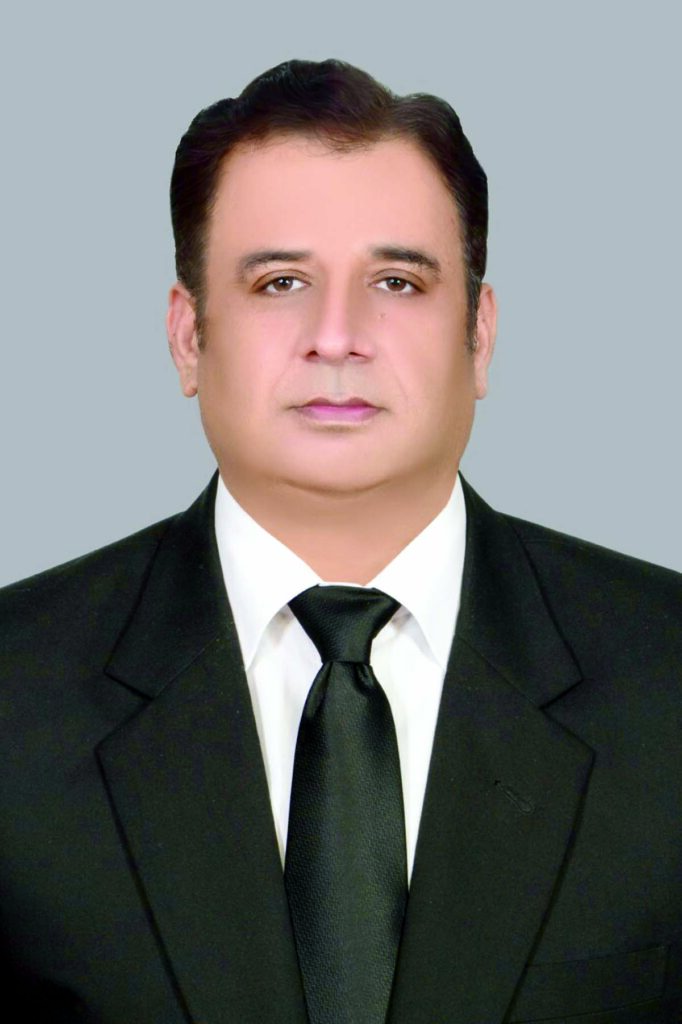
Asif Mahmood
The Chief Commissioner of Islamabad exercises the powers of a provincial government. So would it not be better to make Islamabad a province and have an elected Chief Minister here?
The official website of the Islamabad Administration tells us that the Chief Commissioner exercises his powers as a representative of the provincial government.
A Chief Minister at least has an opposition to deal with. The Chief Commissioner has no opposition at all. A Chief Minister has to face an assembly. The Chief Commissioner has only subordinates before him. There is no Leader of the Opposition to spoil the show. Elected Chief Ministers are, for all practical purposes, merely there for appearances. The real fun belongs to this unelected Chief Minister.
What is astonishing is that neither the Constitution nor any parliament has given the Chief Commissioner of Islamabad powers like those of a Chief Minister. This arrangement, in which a provincial ruler exists in the shape of a Chief Commissioner, was introduced during the colonial era, in 1897, through the General Clauses Act. We have held on to it to this day.
In 1980, through a presidential executive order, we handed Islamabad over to an unelected bureaucrat and then simply forgot that democracy was also the name of a bird worth knowing.
Governments came and went. The Constitution was amended again and again. The contours of the system were redesigned countless times. We kept singing the golden sayings of democracy morning and evening. Yet no one has ever seriously considered this basic question: how can a government servant, who is unelected, be given powers equivalent to those of a Chief Minister?
Islamabad is the only city in Pakistan whose residents have no right to vote for a provincial assembly. Senators are elected from here, but there is no provincial assembly here whose members they can vote for. There is no local government either. A provincial assembly can still be created here. The result is that the feeling of being a stepchild has seeped into the veins of the city.
Urban Islamabad, meaning the Islamabad of the settlers, is largely made up of the elite, so its voice is heard, at least to some extent. But rural Islamabad has been rendered almost completely ownerless. Among the locals (Red Indians) of rural Islamabad, who would dare go to the Chief Commissioner’s office even for his darshan, let alone an actual meeting?
Urban Islamabad constitutes only 30 percent of the city, yet it consumes more than 90 percent of the budget. The Islamabad of the locals (Red Indians) makes up 70 percent of the capital city, but receives not even 10 percent of the budget.
As a result, 9,000 metric tonnes of garbage are collected every day from the Islamabad of the settlers, while there is not even a proper arrangement for collecting garbage from the Islamabad of the Red Indians. If anyone finds this hard to believe, they should take a trip to Tramri in rural Islamabad.
The treatment being meted out to the local rural population is a human tragedy. There are no good educational institutions, no clean drinking water. These people have neither access to the bureaucracy to go and present their grievances nor any local or provincial government to understand their problems. The city is in the hands of the CDA, and the CDA has little to do with local wisdom or local problems. It is merely the handmaiden of a few elite sectors and remains busy serving them.
Whenever there is talk of creating new administrative units or provinces, our politicians become furious. Yet there is this strange indifference to the fact that the capital of the country has been handed over to an unelected bureaucrat, who has been given the powers of a Chief Minister.
Our politicians are so afraid of devolving power to the people at the grassroots that when a local government was finally established in Islamabad, its mayor had not even a single rupee in the budget. Nobody gave him a budget. The entire budget remained with the CDA.
The obvious thing to do was to take the budget away from the CDA and hand it over to Islamabad’s elected government. But the federal government did not do that. Instead, it gave the mayor the powers of the Chairman CDA as well, so that he could use the budget.
In other words, if elections are ever held and an elected mayor from another political party happens to come to office, then unless the federal government also gives him the additional charge of Chairman CDA, the mayor will not be able to undertake even a single rupee’s worth of development work.
In these circumstances, the humble request : whether you create new provinces or not, at least take back this unelected Chief Minister of Islamabad.
High Courts exist in the provinces, and Islamabad has a High Court. Bar councils belong to the provinces, and Islamabad has a Bar Council. An IG is also a provincial office, and Islamabad has an IG.
So why can Islamabad not be made a province? And why can the powers of a Chief Minister not be taken away from a bureaucrat and entrusted to an elected representative of the people?