


Dr. Akhter Hameed Khan, a visionary social scientist and the architect of Pakistan’s famous Orangi Pilot Project, devoted his life to improving the living conditions of low-income communities through self-help and community participation. Continuing his mission, the Akhter Hameed Khan Foundation (AHKF) works to strengthen local communities by improving access to education, health, sanitation, and livelihoods through people-centered development.
In partnership with Research and Development Solutions (RADS) — a leading Pakistani research and data organization — AHKF has launched an innovative health initiative that brings quality healthcare directly to people’s homes. This project combines community health work with real-time data monitoring to ensure transparency, accountability, and better health outcomes.
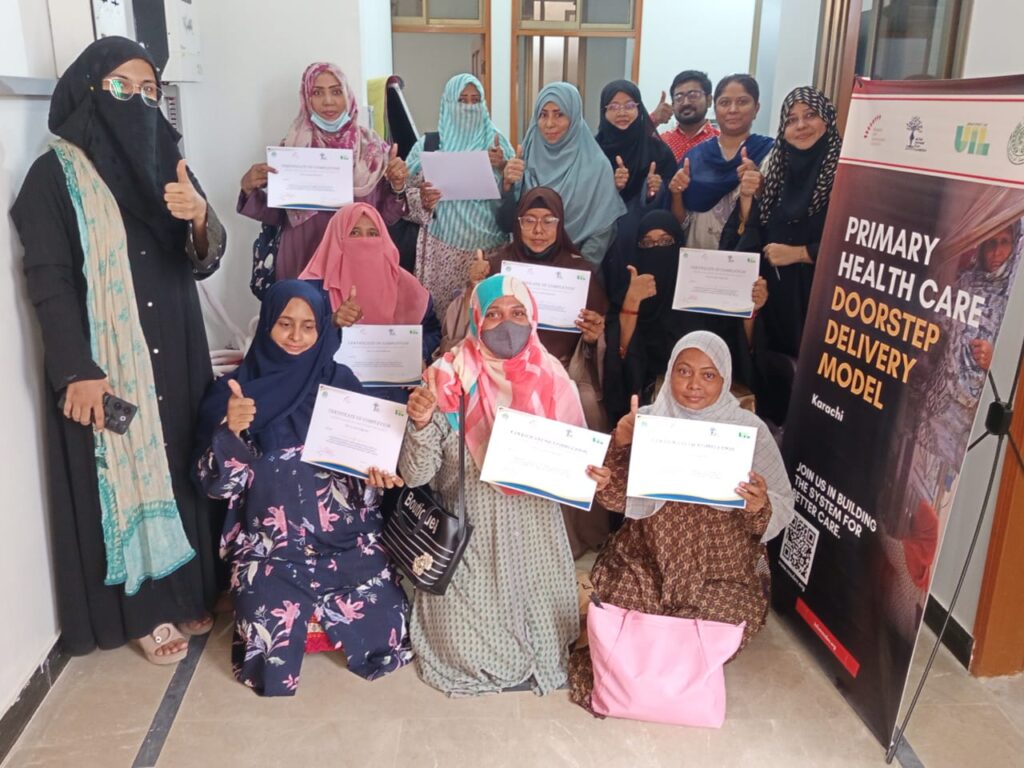
Under the Primary Healthcare (PHC) Doorstep Delivery program, trained community health workers known as Aapis are now visiting households regularly to record family health profiles, check nutrition levels, monitor immunization status, and screen for chronic diseases.
Supporting them are Rahbars — trained male community mobilizers who work to raise awareness among men about health, hygiene, and preventive care. They help build trust between families and health workers, encourage participation in health programs, and ensure community-level ownership of the initiative.
Through this model, healthcare is moving from distant clinics right into people’s homes — ensuring that no family is left behind.
RADS has introduced modern tools like live dashboards, automated checks, and real-time monitoring systems that guarantee accuracy in data collection. This partnership allows AHKF to focus on community mobilization and service delivery, while RADS ensures that every visit and every health record is backed by reliable, verified information.
To strengthen implementation, RADS conducted five four-day training workshops across Karachi and Rawalpindi, training over 100 Aapis, 14 Cluster Leaders, and 14 Rahbars. Experts from local health departments — including Dr. Asma from Rawalpindi, Dr. Shazia Baloch (Additional DHO-West), and Dr. Tariq Bhatti (ADHO-West) — also participated to align community-level data with government health systems.
The first phase of the project will be carried out in Orangi Town, Karachi — one of the largest low-income and informal settlements in South Asia. The initiative aims to reach around 250,000 underserved residents, including women, children, the elderly, and migrant families. The goal is to promote early health-seeking behavior, strengthen coordination between communities and health departments, and use digital innovation to improve access to primary healthcare.
By combining technology with community trust, the AHK Foundation and RADS are shaping a new model for Pakistan — one where healthcare is evidence-based, inclusive, and truly at the doorstep of every family.