


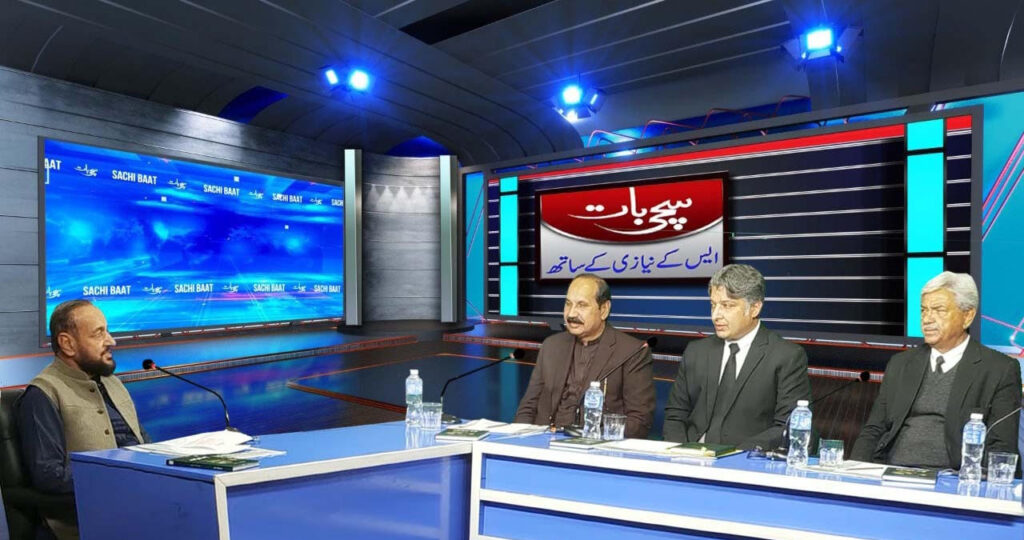
Speakers praise improvements in the Supreme Court, stress constitutional procedures for new provinces and call for public relief and economic reforms
By Staff Reporter
ISLAMABAD: Editor-in-Chief Pakistan Group of Newspapers and Chairman Roze News SK Niazi, while speaking in his renowned talk show Sachi Baat, appreciated the services and cooperation of Syed Amjad Shah, President Supreme Court Bar, for helping resolve various issues amicably. He praised improvements in the Supreme Court, saying judicial performance should be assessed through its decisions and delivery of justice. He also commended the Chief Justice for handling important cases and ensuring speedy proceedings, stressed that the judiciary must make independent decisions without government pressure and that access to justice should be made easier for ordinary citizens, particularly those unable to afford legal expenses. Discussing new provinces, he said the issue should be taken to the appropriate constitutional forum and political leadership must clearly state its position. He added that decisions should reflect public needs rather than political interests. expressed concern over rising poverty, inflation, corruption, declining remittances and the slowdown in business and exports. He urged the government to reduce the financial burden on citizens, improve basic services and take effective measures against corruption. He also stressed that federal resources received from the provinces should be spent on public welfare.
President Supreme Court Bar Syed Amjad Shah said the Supreme Court was moving towards modernisation through digitalisation and e-filing, allowing cases to be filed from anywhere in the country. He said work was underway to make the court paperless, reduce paperwork and facilitate lawyers and litigants. He also highlighted progress in the Federal Constitutional Court, saying its establishment had begun reducing the Supreme Court’s backlog and pending cases.
He maintained that the judicial system had improved but still required further reforms. Emphasising that his position was based on constitutional and legal matters, he said Parliament had the authority to amend the Constitution, provided the prescribed procedures were followed. He added that constitutional amendments require approval from both houses of Parliament, while certain matters also require resolutions from the relevant provincial assembly.
On new provinces, he said the matter was political but must be addressed through constitutional and democratic procedures, with consultation among all stakeholders. He acknowledged demands for new provinces, including Bahawalpur, and said smaller administrative units could help improve governance. He also stressed that lasting peace required economic prosperity, basic necessities and relief for the public, adding that economic empowerment could help reduce corruption. He called for expanding trade with regional and international markets, including Bangladesh, Sri Lanka and China.
Legal Expert Babar Khan Yousafzai discussed administrative and legal developments in Khyber Pakhtunkhwa, including notifications concerning institutional powers, university positions and recruitment. He said proceedings relating to the Khyber Pakhtunkhwa Bar Council were scheduled to begin on the 7th and that he had decided to become a party to the case in view of public concerns. He stressed that the province’s public issues should also receive attention.
Regarding the referendum process, he explained that following the 18th Constitutional Amendment, approval from both the National Assembly and Senate was required for a referendum on an important national issue. He described the situation surrounding the notifications and court proceedings as unusual and declined to comment on the court order.
Federal Parliamentary Secretary for Commerce Zulfiqar Ali Bhatti appreciated improvements in the judicial system and said institutional performance should be discussed separately from political disagreements. He maintained that judicial decisions providing relief to citizens deserved encouragement and that political parties should not assess the judiciary solely according to whether a decision favoured them.
He said constitutional and parliamentary procedures must be followed in matters concerning the creation of new provinces, adding that Parliament had the authority to decide such matters within the constitutional framework. He stressed that the issue should be discussed in Parliament rather than treated merely as a political debate.
Addressing economic concerns, he acknowledged that inflation and corruption remained challenges and called for practical measures to provide relief to citizens. He said steps had been taken to address industrial and tax-related issues and improve the business environment, but the benefits of government initiatives must reach ordinary people. He further stressed that federal and provincial resources should be used for public welfare, with financial responsibilities and the interests of all provinces taken into account.