


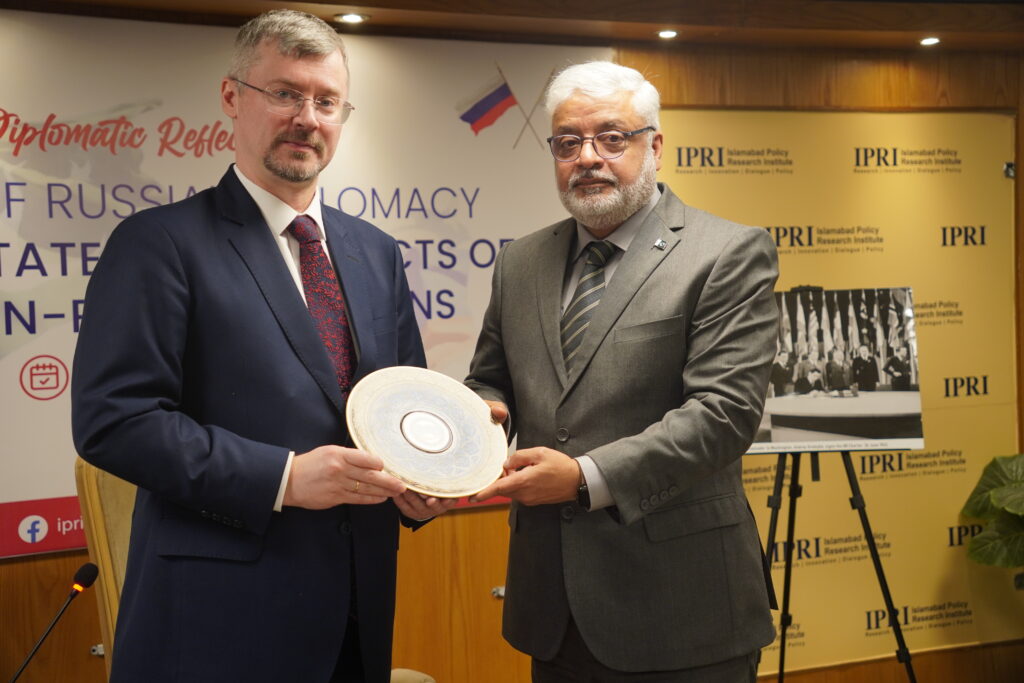
Lt General Majid Ehsan, President of IPRI,
First of all, I would like to highlight that today’s event is taking place on the eve of Diplomats’ Day, a professional holiday celebrated by employees of the Russian Ministry of Foreign Affairs and its subordinate agencies annually on February 10.
This date was chosen for a reason. On February 10, 1549, Russia established the Ambassadorial Service, its first independent foreign affairs institution. However, Russian diplomacy had already come a long way by that time, having developed over several centuries.
Starting in the 9th century, the state of Ancient Rus was an active participant in European international relations. A significant event occurred in 838 when a Russian embassy traveled to Constantinople, marking the first time that Rus was represented as an independent state at the court of the Byzantine emperor. In 860, the state gained international recognition by signing the Treaty of Peace and Love with the Byzantine Empire. It is the first known treaty in Russian history.
Sources indicate that, by the 11th century, a diplomatic hierarchy had formed in Rus that distinguished between an “ambassador” and an “envoy.” Russian rulers were interested in recruiting educated individuals for diplomatic affairs, and they encouraged the study of foreign languages and communication with foreigners. After Rus adopted Christianity, literate clergymen were recruited for diplomatic service and greatly contributed to successful negotiations with Christian countries.
During the Mongol invasion of Rus (13th–15th centuries), Russian princes and their envoys pursued a balancing policy between the powerful invaders and the interests of the Russian principalities. They sought to reunite a country divided by the invasion. Alexander Nevsky was a key figure in developing a new model of diplomacy during this period. He was one of the first to choose the “path of compromise,” consciously avoiding confrontation with the Golden Horde because he understood that open resistance would lead to further destruction. This policy preserved the Orthodox Church, which united all Russian principalities under its banner. It also protected monasteries and dioceses from ruin and supported literacy and education.
As the Russian state grew stronger in the 15th and 16th centuries, regional diplomacy gave way to a unified approach. Moscow became a formidable political force, claiming a special place in the system of international relations that required establishing permanent contact with foreign states. In 1549, Russian Tsar Ivan IV established the Ambassadorial Service, a special institution responsible for maintaining relations with foreign states.
Ivan Viskovaty became its first head. His contemporaries noted his exceptional diplomatic and oratorical abilities. During his tenure, 32 embassies from various countries visited Moscow. Viskovaty participated in nearly all negotiations with foreign ambassadors and played a significant role in Russian foreign policy.
Throughout Russian history, many talented statesmen have led the Russian Foreign Ministry. You can learn about some of the most prominent ones by exploring the exhibition in this hall. I will discuss some of them in more detail:
Vasily Golitsyn was a brilliant, well-educated statesman who spoke several ancient and European languages. From 1682 to 1689, he led the Ambassadorial Service. During his tenure, the first treaty in Russian-Chinese relations was signed, establishing the border between the two countries (finalized in 1689 in Nerchinsk). A major success of his foreign policy was the “Eternal Peace” treaty with the Polish-Lithuanian Commonwealth in 1686, which secured Ukraine’s reunification with Russia.
Andrei Osterman was born in Germany and entered Russian service in 1704. He rose through the ranks from secretary of the Ambassadorial Service to vice president of the Collegium of Foreign Affairs. Peter the Great held Osterman’s intellect and abilities in high regard and considered him a close associate. During the Great Northern War, Osterman participated in negotiations with Sweden, aiming to secure favorable terms for a future peace agreement. As one of the Russian representatives, his signature appears on the 1721 Treaty of Nystad, which was a significant victory for Russian diplomacy, strengthening the country’s international position. Under its terms, Russia gained access to the Baltic Sea. Russia became Osterman’s new homeland not by birth, but through love and service. An educated man with a sharp analytical mind, he was an active statesman who always guided his foreign policy by the interests of Russia.
Karl Nesselrode was the longest-serving head of Russia’s foreign ministry, leading the institution for 40 years from 1816 to 1856. During that period, he participated in the preparation and conclusion of numerous agreements that determined Russia’s position in the international arena: the Treaty of Turkmenchay with Persia, the Treaty of Adrianople with the Ottoman Empire, the London Conventions on the Straits, and the Concordat with the Pope. Nesselrode also led large-scale diplomatic operations that successfully resolved two crises in the Middle East.
Alexander Gorchakov, who served as Minister of Foreign Affairs for 25 years, is one of the most prominent diplomats in Russian history. He received an excellent education at the Tsarskoye Selo Lyceum, where his closest friend was the renowned Russian poet Alexander Pushkin, who predicted a brilliant future for him. Gorchakov led the Ministry of Foreign Affairs during a challenging period for Russia in the latter half of the 19th century when the country was isolated on the international stage. Gorchakov proposed a new foreign policy course in this situation, according to which Russia refrained from active participation in European affairs for some time and focused mainly on domestic policy issues. Gorchakov is credited with the famous phrase, “They say Russia is angry. Russia is not angry. Russia is concentrating.”
Gorchakov paid considerable attention to supporting the Balkan peoples’ aspirations for independence. Thanks in part to his efforts, Bulgaria, Serbia, Romania, and Montenegro became independent countries. His main diplomatic victory was abolishing the restrictive provisions of the 1856 Paris Peace Treaty that prohibited Russia from having military fleets and arsenals on the Black Sea.
In May 1918, Georgy Chicherin became head of the Russian Foreign Ministry. A highly educated and broad-minded individual with knowledge of the inner workings of the tsarist Foreign Ministry, Chicherin played a significant role in shaping Soviet Russia’s foreign policy and establishing its diplomatic apparatus amidst complete political and economic isolation. Important treaties were signed with our eastern neighbors—Afghanistan, Iran, and Turkey—under his leadership. He is also associated with the “wave of recognition” of 1924–1925, which involved the USSR establishing diplomatic relations with several Western countries, as well as China and Japan.
In May 1939, Vyacheslav Molotov became head of the USSR People’s Commissariat for Foreign Affairs. He was responsible for shifting Soviet diplomacy away from the pre-war policy of ensuring collective security in Europe and toward resolving the issue of the country’s security independently. Molotov was tasked with informing the Soviet people of Nazi Germany’s attack on the USSR on June 22, 1941. His words, “Our cause is just. The enemy will be defeated. Victory will be ours,” became the slogan of the Great Patriotic War. Under Molotov’s leadership, Soviet diplomacy successfully established and strengthened the anti-Hitler coalition.
Molotov participated in international conferences with the heads of government of the USSR, USA, and Great Britain, primarily in Tehran, Yalta, and Potsdam. These conferences determined the course of the war and established the basis for a peaceful postwar settlement. Molotov also participated in the San Francisco conference, where the United Nations was established.
Andrei Gromyko was appointed Minister of Foreign Affairs of the USSR in February 1957, a position he held until July 1985. He began his diplomatic career in the United States, during the most difficult period of the Second World War. In 1943, he became one of the youngest ambassadors and worked hard to improve Soviet-American relations. As head of the delegation at the negotiations for the formation of a universal international organization, Gromyko participated in drafting and signing the UN Charter. In 1946, he became the first Soviet representative to the UN.
On May 1, 1948, Russia and Pakistan established diplomatic relations as a result of an agreement reached in New York between Andrei Gromyko and Zafrullah Khan, the Foreign Minister of Pakistan.
During Gromyko’s tenure as Foreign Minister, the Soviet Union played an important role in establishing a negotiating platform for the leaders of Pakistan and India in Tashkent, the capital of the former Uzbek SSR, in 1965–1966. Consequently, 60 years ago, the Tashkent Declaration was signed, marking an agreement to cease hostilities between Islamabad and New Delhi, with Soviet diplomacy playing a leading role.
During Gromyko’s tenure, critical international situations arose on more than one occasion that could have led to global armed conflicts. The successful resolution of the Cuban Missile Crisis is a classic example of how diplomacy found a dignified way out of a situation when the world was literally hanging by a thread. For Gromyko, the “question of questions”, as he himself used to say, was the negotiation process for controlling the arms race, both conventional and nuclear. Numerous agreements and treaties were prepared and signed with his participation in this area, including the 1963 Treaty Banning Nuclear Weapon Tests in the Atmosphere, in Outer Space, and Under Water; the 1968 Treaty on the Non-Proliferation of Nuclear Weapons; the 1972 ABM Treaty; and SALT I.
Yevgeny Primakov led the Russian Foreign Ministry from 1996 to 1998. His name is directly associated with significant changes in the content and style of Russian foreign policy. According to Russian President Vladimir Putin, thanks to Primakov, “respect for our country began to return to world diplomacy, and an understanding of the unconditional priority of national interests took hold in the work of the Foreign Ministry.”
Drawing on the historical experience of Russian diplomacy, Primakov emphasized the importance of Russia pursuing an active, multi-vector policy with both Western and Eastern countries. Under Primakov, relations with CIS countries intensified. In the spring of 1996, an agreement was drafted and signed for the formation of the Economic and Customs Union of Russia, Belarus, Kazakhstan, and Kyrgyzstan, which would become the prototype for the Eurasian Economic Union (EAEU). In April 1997, the Treaty on the Union of Russia and Belarus was signed.
One particularly memorable event was the so-called “Primakov loop” or “turn over the Atlantic.” On March 24, 1999, Yevgeny Primakov, who was then the prime minister of Russia, was en route to the United States on an official visit. However, upon learning of NATO’s decision to bomb Yugoslavia during the flight, he ordered the plane, which was over the Atlantic Ocean, to turn around and return to Moscow. This event signaled Russia’s shift toward a multi-vector foreign policy and demonstrated Russia’s bold and principled position on the world stage.
The priorities of Russia’s foreign policy at the present stage are to uphold the principles and goals of the UN Charter in their entirety and interconnection, to form a truly multipolar world order based on the principle of sovereign equality of all countries, to combat neo-Nazism and neo-colonialism, to preserve the historical memory of the outcome of World War II, and to prevent the rewriting of its history.
Turning to the topic of the current state and prospects of Russia-Pakistan relations, I would like to reiterate that their history began in 1948, shortly after the Islamic Republic of Pakistan gained independence. The Cold War proved to be a difficult period for bilateral relations, yet ties between our peoples developed in various areas. In the 1960s, the USSR assisted Pakistan in developing its energy sector, including creating a national oil and gas company, exploration, and mineral extraction. With the help of Soviet specialists, the metallurgical plant in Karachi, as well as the Guddu, Jamshoro, and Muzaffargarh thermal power plants, were built from the 1970s to the 1990s.
In the 2000s, a new impetus was given to the development of cooperation between Moscow and Islamabad when the Russian Federation, successor to the USSR, embarked on an active, multi-vector foreign policy, increasing interaction with countries in the Global South. Today, we can confidently say that the friendship between Russia and Pakistan is growing stronger every year.
We have established a dynamic and constructive political dialogue, which helps us sustain the positive momentum of our bilateral cooperation. Our countries maintain regular high-level contacts; last year, our leaders met twice, in Beijing in September and in Ashgabat in December.
Our interparliamentary ties are also very strong. Friendship groups operate in the legislative assemblies of our countries. From 2024 to 2025, the speakers of the upper houses of the Russian and Pakistani parliaments exchanged visits. In November of last year, a Russian delegation led by the deputy speakers of the Federation Council and the State Duma visited Islamabad to participate in the Inter-Parliamentary Speakers’ Conference.
In 2025 alone, the Foreign Ministers of Russia and Pakistan held three in-person meetings at multilateral events. The Russian and Pakistani foreign ministries have consultative mechanisms in place to address bilateral and regional issues, strategic stability, and countering international terrorism and other new security challenges. These meetings are held annually, alternating between Moscow and Islamabad.
Russia and Pakistan effectively coordinate their efforts in the international arena, primarily at the UN and SCO. We are united by our commitment to the ideas of a just, polycentric world order; fair, equitable world trade; the principle of the UN’s leading role in international relations; traditional values; and the preservation of cultural heritage and historical truth. Together, we oppose international terrorism, extremism, neocolonialism, neo-Nazism, Islamophobia, and all forms of discrimination based on national or religious identity.
We are exploring opportunities to expand trade and economic cooperation. Bilateral institutions, such as the Intergovernmental Commission on Trade, Economic, Scientific, and Technical Cooperation (IGC) and its working groups, as well as the Business Council for Cooperation with Pakistan under the Russian Chamber of Commerce and Industry, play a pivotal role in this endeavor. The Russian Trade Mission in Islamabad is actively engaged in this work.
A number of promising projects have already been identified. These include restoring the Karachi Steel Mills, launching a railway connection between our countries via the North-South International Transport Corridor, organizing joint production of medicines (including insulin) in Pakistan, participating in developing plans for local hydropower development, constructing new hydroelectric power plants and modernizing existing ones, and developing oil and gas fields in Pakistan.
Against the backdrop of illegal anti-Russian sanctions, we are cooperating with relevant Pakistani authorities to identify ways to ensure uninterrupted trade between our countries. Our focus is on developing reliable alternative payment mechanisms. Plans to implement pilot barter and exchange operations are under discussion within the framework of the IGC.
We see potential for cooperation between Islamabad and BRICS and its New Development Bank. Additionally, given the establishment of diplomatic relations between Pakistan and Armenia, we believe there is potential for engagement with the EAEU as well.
We prioritize humanitarian contacts, educational exchanges, and cultural exchanges. The Russian House in Karachi is doing a good job in this regard. Last year, Russia tripled the number of scholarships for Pakistani students to study at Russian universities, increasing it to 152. The Russian language centers and courses operating in Islamabad, Karachi, Lahore, and Sargodha also play an important role. Additionally, Pakistan participates in the international federal project “Russian Teacher Abroad,” through which Russian teachers are sent to foreign countries at the request of partners to organize long-term teaching programs. We are actively looking into ways to involve Pakistani universities and schools in this project.
The Russian Embassy in Islamabad is making every effort to promote the comprehensive development of bilateral relations. Last November, we helped organize the 10th IGC meeting and related events, including a concert by the Russian folk ensemble “Russia” at the PNCA and the installation of a monument to the first cosmonaut, Yuri Gagarin, in Fatima Jinnah Park.
We maintain regular contact with scientific and educational circles in Pakistan and organize events featuring local experts, teachers, and students. On December 18, 2025, we organized a conference at the Embassy dedicated to bilateral relations. Prominent representatives of scientific circles from Islamabad and other cities across the country attended the conference.
We will continue working to realize the full potential of Russia-Pakistan relations.
Thank you for your attention. I am ready to answer your questions.