


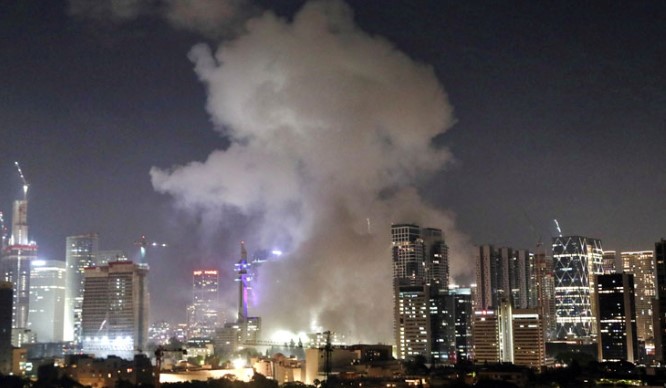
JERUSALEM/DUBAI: Israel launched heavy airstrikes against Iranian strategic defence systems and energy infrastructure on Monday, hitting a major petrochemical plant and triggering a second wave of retaliatory Iranian ballistic missiles that sent sirens blaring across Israel.
The sharp escalation directly defied warnings from US President Donald Trump, who had just urged Israeli Prime Minister Benjamin Netanyahu to halt further attacks to protect fast-moving, closed-door peace talks with Tehran.
The exchange marked the first direct hits between the regional adversaries since an April 8 ceasefire, threatening to collapse months of fragile, US-led diplomacy aimed at ending a wider regional war that began on February 28.
The hostilities immediately rattled global energy markets, sending benchmark Brent crude futures surging more than 3 per cent to top $96 a barrel.
Strategic Infrastructure Struck
In a morning blitz, the Israel Defense Forces (IDF) said they targeted surface-to-surface missile sites, infrastructure, and “large-scale” strategic defence networks across Iran.
Iranian state media confirmed explosions and air defense activations in Tehran, Isfahan, and Tabriz.
The centerpiece of the Israeli assault was the Karun petrochemical plant within the critical Mahshahr port complex in southwestern Iran—the fifth time lines at the facility have been hit since the war began.
According to Iran’s semi-official Mehr news agency, authorities ordered an immediate evacuation of the area. While parts of the facility sustained damage, local officials reported no initial casualties. In response, local governance slashed regional office staffing by 70 per cent to conserve emergency bandwidth.
Tehran’s Islamic Revolutionary Guard Corps (IRGC) quickly retaliated, accusing Israel of starting a “dangerous game” by targeting civilian and energy sectors.
The IRGC claimed it successfully launched a missile targeting a parallel petrochemical plant in the northern Israeli port city of Haifa.
The IRGC further claimed a strike on the Ramat David airbase near Nazareth, utilizing air-launched ballistic missiles.
Israel’s national ambulance service, Magen David Adom, reported scanning multiple areas but found no immediate casualties, as Israeli air defense systems intercepted the bulk of the incoming salvos.
Airspace Grounded, Diplomatic Fractures
The strikes caused immediate domestic disruption within Iran. The Civil Aviation Organization grounded all commercial aviation “until further notice,” shutting down Mehrabad International Airport in Tehran and Kermanshah International Airport in western Iran as military activity filled the skies.
In Tehran, Foreign Ministry spokesperson Esmaeil Baghaei directed blame toward Washington during a tense press conference, stating that Israel’s actions “cannot be looked at in isolation from the United States.”
“The United States holds direct responsibility for the current ceasefire violations,” Baghaei said.
Baghaei also lambasted International Atomic Energy Agency (IAEA) Chief Rafael Mariano Grossi, accusing the UN nuclear watchdog of “deliberate bias against Iran” that undermines the agency’s legitimacy.
Trump Claims ‘I Call the Shots’
The battlefield escalation exposed a glaring disconnect between Israel’s military actions and Washington’s diplomatic strategy.
On Sunday, Trump spoke via telephone with Netanyahu for nearly 30 minutes from his golf club in Bedminster, New Jersey. According to a U.S. official quoted by Axios, Trump explicitly told Netanyahu to hold off on military operations because “we are close to doing something good in terms of a deal.”
Despite the subsequent strikes, a defiant Trump insisted that the flare-up would not derail a comprehensive agreement to end the 100-day-old war, which currently centers on reopening the blockaded Strait of Hormuz.
“It’s not going to have any impact on the deal,” Trump told the *Financial Times*. “I call the shots. I call all the shots. He [Netanyahu] doesn’t call the shots.”
Lebanon Complication
The fragile peace framework has been continually strained by Israel’s parallel military campaign in Lebanon against Hezbollah. While U.S. officials insist the Lebanon theater must be treated separately, Tehran maintains that any permanent peace deal is contingent on a synchronized ceasefire in Lebanon.
The latest round of violence actually began over the weekend in the suburbs of Beirut. Israel launched airstrikes on the Dahiyeh district—the first such strikes since the U.S. introduced a Lebanon truce framework last week—killing at least two people and wounding 20. Netanyahu justified the strikes as a necessary response to Hezbollah rocket fire.
The regional matrix of the conflict widened further on Monday when Yemen’s Iran-aligned Houthi movement claimed responsibility for a separate missile strike on Israel, pledging to completely halt Israeli maritime navigation in the Red Sea. “We consider all enemy movements to be legitimate military targets,” the group announced.
High Stakes at the Negotiating Table
The underlying negotiations aim to resolve a grueling strategic stalemate. Since early April, Iran has blocked the Strait of Hormuz—choking off a fifth of the world’s crude oil and liquefied natural gas—while Washington has maintained a strict counter-blockade of Iranian ports.
Friction is also mounting over asset allocation. Sources close to the White House indicated Washington is exploring transferring seized Iranian assets to Gulf Arab neighbors to pay for regional war damages. Iran’s Deputy Foreign Minister Kazem Gharibabadi warned on Sunday that any such diversion would be considered illegal and would trigger severe Iranian countermeasures.
With both sides trading heavy blows while simultaneously signaling an appetite for a deal, Middle East stability remains balanced on a razor’s edge, tested by Trump’s pressure tactics and Netanyahu’s insistence on independent military deterrence.