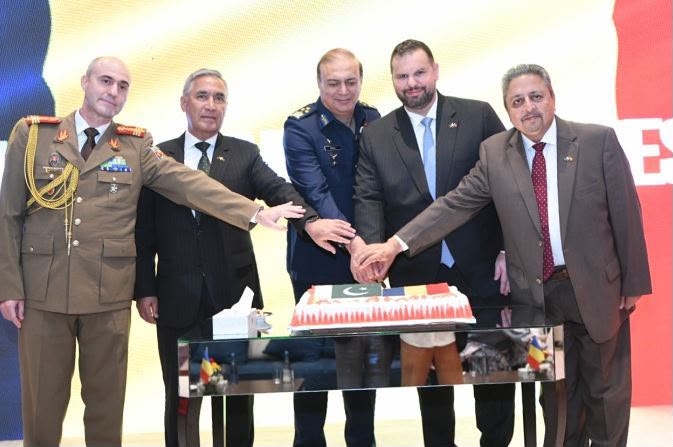
October 25th marks one of the most important national
holidays, a day when the Romanian people pay tribute to their
Armed Forces—honouring its feats of arms from both the distant
and recent past, as well as all those currently serving in uniform
who remain constantly on duty.
As a NATO and UE member, Romania considers the
transatlantic bond to be the key element ensuring the Alliance’s
strength and success—a fact demonstrated by over 70 years of
peace across Allied territory. In this same spirit, the US presence
in Europe is the result of more than 75 years of partnership,
cooperation, and mutual support for European democracies—
factors that have fostered stability, security, and the maintenance
of peace, ultimately leading to a free and independent Europe.
The situation resulting from the Russian Federation’s
military aggression against Ukraine—coupled with Russia
being identified in NATO’s 2022 Strategic Concept as the most
significant and direct threat to the Alliance’s security—has
triggered a wave of substantial investment in the equipping and
modernization of European armed forces.
Against this backdrop, and in accordance with the
commitments undertaken by the Allies at the 2025 NATO
Summit in The Hague, Romania aims to allocate 3.5% of its
GDP to direct defense investments, as well as 1.5% of its GDP
to other indirect investments in defense and security, by 2035.
Romania is among the states benefiting from financial
mechanisms funded by the European Union through the
Readiness 2030 plan. From a national perspective, this program
provides an opportunity to increase defense spending and will
also have a positive impact on the defense industry.
The modernization of the Romanian Armed Forces is one
of Romania’s strategic priorities, within the context of adapting to
evolving security conditions and strengthening national defense
capabilities.
To this end, Romania continues to invest in equipping and
modernizing all service branches, focusing on the development of
air and missile defense capabilities, combat aviation, and land and
naval forces, as well as on the integration of new technologies,
including unmanned and anti-drone systems. Concurrently,
efforts are directed toward modernizing military infrastructure,
bolstering logistics capabilities, and developing the national
defense industry.
The European financial instrument “Security Action for
Europe” (SAFE)—part of the European Union’s efforts to
strengthen defense capabilities and the European defense
industrial and technological base—plays a significant role in
achieving these objectives.
Romania benefits from an allocation of 16.68 billion EURO
through this instrument, which enables the acceleration of
procurement programs and the development of industrial
cooperation projects in the defense sector.
The strategic importance of the Black Sea region has grown
exponentially in recent years, with Russia acting as the primary
player—both militarily and politically—in every regional security
issue, to the detriment of the security of other states. Russia’s
2008 invasion of Georgia, its 2014 annexation of Ukrainian
Crimea, and the war of aggression launched against Ukraine in
2022 have transformed the Black Sea region into a frontline of
the Russian offensive against both the rules-based
international order and the core of Euro-Atlantic security.
In 2026, Russia continued to attack Ukrainian ports on
the Danube, near Romania’s borders. Consequently, these attacks
led to incidents within Romanian airspace. We faced a wave of
unauthorized drone incursions into Romanian airspace, with the
first nine months of 2026 seeing a threefold increase in such
incidents compared to the previous year. For the first time since
the start of the war in Ukraine, four of these drones were shot
down by the Romanian Air Force. The exponential rise in the
number of these incidents signals a serious deterioration of
the security environment in the vicinity of Romania and
Allied territory.
Incidents involving aerial and maritime drones,
cyberattacks, and the increasingly prevalent disinformation
orchestrated by Moscow demonstrate mounting pressure and
serve as a test of Allied resilience.
As a NATO member, Romania remains a staunch supporter
of a coherent approach to measures aimed at strengthening the
collective deterrence and defense posture, as well as an active
contributor to the implementation of forward defense.
Also, Romania contributes to all military missions and
operations conducted under the aegis of the EU’s Common
Security and Defence Policy. The Eastern Neighbourhood and
the Western Balkans are priority areas for Romania in ensuring
peace and stability. It is worth noting that Romania holds the
command of the EUTM mission in the Central African Republic
for the fourth time.
The Eastern Neighborhood also remains a priority for our
country. The Republic of Moldova faces multiple security
challenges, including attempts at destabilization that are part of
the Russian Federation’s hybrid actions. The Republic of Moldova
is part of the European family, and we firmly support its path,
including the goal of accession by 2030.
Regarding assistance for Ukraine, we will continue to
contribute to strengthening security by providing
multidimensional support to Kyiv.
Romania remains steadfast in its continued
multidimensional support for Ukraine. We will remain actively
engaged in the activities of the Ukraine Defense Contact Group,
including within the Capability Coalitions.
Romania is also involved in training Ukrainian military
personnel as part of the EUMAM UA mission. We will continue
to coordinate with our Ukrainian partners to identify further
training opportunities based on their needs.
Ladies and gentlemen, I am very pleased to underline that
the military cooperation between Romanian and Pakistan is
on an upward trend lately which and has been developed over the
years into a true and mutual partnership.
Since there is not enough time to elaborate on the
multifaceted and complex character of the cooperation, I would
just like to highlight the forth session of the Join Military
Committee which took place at Islamabad in last February. The
agenda of this focused-on prospects for bilateral defense
cooperation (such as joint counter-terrorism training, Air Force
training courses, the exchange of experience in military
education, joint naval training, and defense industry cooperation),
the security situation in the Black Sea and South Asia regions, as
well as an exchange of views on current international issues.
We are confident that, in the future, all these discussions will
be put into practice in various forms that will contribute to
strengthening defense ties between the two countries.
Romania is also a constant member of the participation with
officers as military observes to the UN peacekeeping mission,
namely the United Nations Military Observer Group in India
and Pakistan.
Last but not least, I acknowledge and praise the Pakistan’s
continued efforts for peace and stability in the region, the
exceptional professionalism and commitment of the Pakistani
military personnel, their sacrifices in fighting terrorism, their
presence in multiple international coalitions authorized to
participate in maintaining peace, humanitarian assistance and
other operations meant to ease the sufferings of the people in
different regions of the world.
Your excellency, Air Marshal SHAKEEL GHAZANFER –Deputy Chief of Air Staff (Project), ladies and gentlemen, dearfriends and guests,
Published: October 20, 2026


October 25th marks one of the most important national
holidays, a day when the Romanian people pay tribute to their
Armed Forces—honouring its feats of arms from both the distant
and recent past, as well as all those currently serving in uniform
who remain constantly on duty.
As a NATO and UE member, Romania considers the
transatlantic bond to be the key element ensuring the Alliance’s
strength and success—a fact demonstrated by over 70 years of
peace across Allied territory. In this same spirit, the US presence
in Europe is the result of more than 75 years of partnership,
cooperation, and mutual support for European democracies—
factors that have fostered stability, security, and the maintenance
of peace, ultimately leading to a free and independent Europe.
The situation resulting from the Russian Federation’s
military aggression against Ukraine—coupled with Russia
being identified in NATO’s 2022 Strategic Concept as the most
significant and direct threat to the Alliance’s security—has
triggered a wave of substantial investment in the equipping and
modernization of European armed forces.
Against this backdrop, and in accordance with the
commitments undertaken by the Allies at the 2025 NATO
Summit in The Hague, Romania aims to allocate 3.5% of its
GDP to direct defense investments, as well as 1.5% of its GDP
to other indirect investments in defense and security, by 2035.
Romania is among the states benefiting from financial
mechanisms funded by the European Union through the
Readiness 2030 plan. From a national perspective, this program
provides an opportunity to increase defense spending and will
also have a positive impact on the defense industry.
The modernization of the Romanian Armed Forces is one
of Romania’s strategic priorities, within the context of adapting to
evolving security conditions and strengthening national defense
capabilities.
To this end, Romania continues to invest in equipping and
modernizing all service branches, focusing on the development of
air and missile defense capabilities, combat aviation, and land and
naval forces, as well as on the integration of new technologies,
including unmanned and anti-drone systems. Concurrently,
efforts are directed toward modernizing military infrastructure,
bolstering logistics capabilities, and developing the national
defense industry.
The European financial instrument “Security Action for
Europe” (SAFE)—part of the European Union’s efforts to
strengthen defense capabilities and the European defense
industrial and technological base—plays a significant role in
achieving these objectives.
Romania benefits from an allocation of 16.68 billion EURO
through this instrument, which enables the acceleration of
procurement programs and the development of industrial
cooperation projects in the defense sector.
The strategic importance of the Black Sea region has grown
exponentially in recent years, with Russia acting as the primary
player—both militarily and politically—in every regional security
issue, to the detriment of the security of other states. Russia’s
2008 invasion of Georgia, its 2014 annexation of Ukrainian
Crimea, and the war of aggression launched against Ukraine in
2022 have transformed the Black Sea region into a frontline of
the Russian offensive against both the rules-based
international order and the core of Euro-Atlantic security.
In 2026, Russia continued to attack Ukrainian ports on
the Danube, near Romania’s borders. Consequently, these attacks
led to incidents within Romanian airspace. We faced a wave of
unauthorized drone incursions into Romanian airspace, with the
first nine months of 2026 seeing a threefold increase in such
incidents compared to the previous year. For the first time since
the start of the war in Ukraine, four of these drones were shot
down by the Romanian Air Force. The exponential rise in the
number of these incidents signals a serious deterioration of
the security environment in the vicinity of Romania and
Allied territory.
Incidents involving aerial and maritime drones,
cyberattacks, and the increasingly prevalent disinformation
orchestrated by Moscow demonstrate mounting pressure and
serve as a test of Allied resilience.
As a NATO member, Romania remains a staunch supporter
of a coherent approach to measures aimed at strengthening the
collective deterrence and defense posture, as well as an active
contributor to the implementation of forward defense.
Also, Romania contributes to all military missions and
operations conducted under the aegis of the EU’s Common
Security and Defence Policy. The Eastern Neighbourhood and
the Western Balkans are priority areas for Romania in ensuring
peace and stability. It is worth noting that Romania holds the
command of the EUTM mission in the Central African Republic
for the fourth time.
The Eastern Neighborhood also remains a priority for our
country. The Republic of Moldova faces multiple security
challenges, including attempts at destabilization that are part of
the Russian Federation’s hybrid actions. The Republic of Moldova
is part of the European family, and we firmly support its path,
including the goal of accession by 2030.
Regarding assistance for Ukraine, we will continue to
contribute to strengthening security by providing
multidimensional support to Kyiv.
Romania remains steadfast in its continued
multidimensional support for Ukraine. We will remain actively
engaged in the activities of the Ukraine Defense Contact Group,
including within the Capability Coalitions.
Romania is also involved in training Ukrainian military
personnel as part of the EUMAM UA mission. We will continue
to coordinate with our Ukrainian partners to identify further
training opportunities based on their needs.
Ladies and gentlemen, I am very pleased to underline that
the military cooperation between Romanian and Pakistan is
on an upward trend lately which and has been developed over the
years into a true and mutual partnership.
Since there is not enough time to elaborate on the
multifaceted and complex character of the cooperation, I would
just like to highlight the forth session of the Join Military
Committee which took place at Islamabad in last February. The
agenda of this focused-on prospects for bilateral defense
cooperation (such as joint counter-terrorism training, Air Force
training courses, the exchange of experience in military
education, joint naval training, and defense industry cooperation),
the security situation in the Black Sea and South Asia regions, as
well as an exchange of views on current international issues.
We are confident that, in the future, all these discussions will
be put into practice in various forms that will contribute to
strengthening defense ties between the two countries.
Romania is also a constant member of the participation with
officers as military observes to the UN peacekeeping mission,
namely the United Nations Military Observer Group in India
and Pakistan.
Last but not least, I acknowledge and praise the Pakistan’s
continued efforts for peace and stability in the region, the
exceptional professionalism and commitment of the Pakistani
military personnel, their sacrifices in fighting terrorism, their
presence in multiple international coalitions authorized to
participate in maintaining peace, humanitarian assistance and
other operations meant to ease the sufferings of the people in
different regions of the world.