


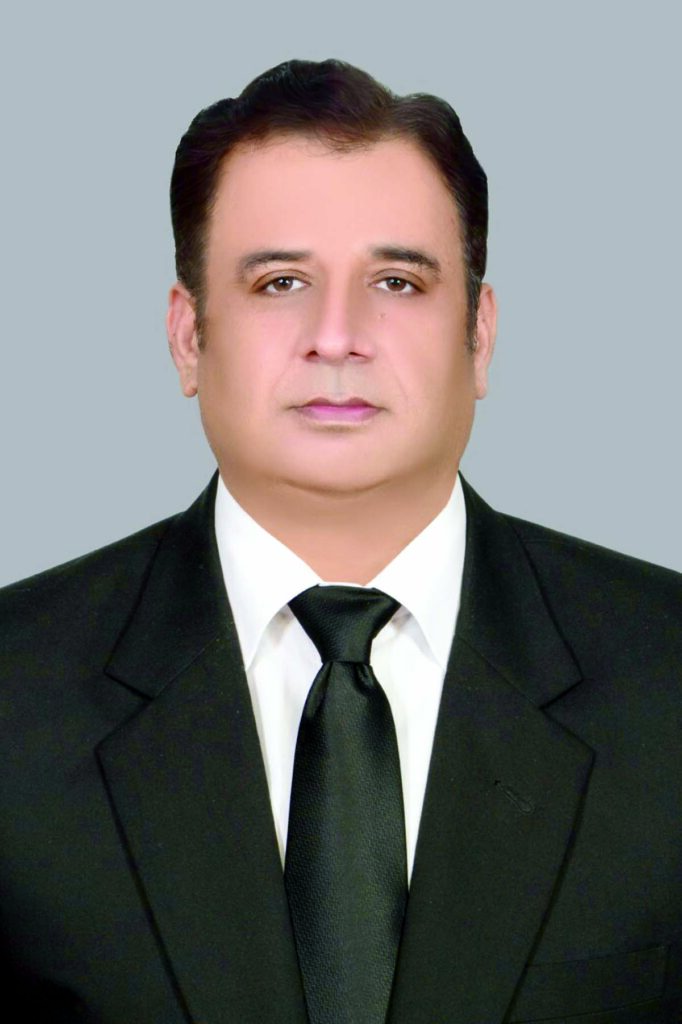
Asif Mahmood
Interior Minister Mohsin Naqvi has suggested that the leader of a political party is upset because he was denied the governorship of Khyber Pakhtunkhwa. Although he has made the remark indirectly, the reference is unmistakably to Maulana Fazlur Rehman, the chief of Jamiat Ulema-e-Islam
In matters such as these, the only way to assess the truth of a claim is to examine it in the light of the circumstances and the sequence of events. Viewed from this perspective, Mohsin Naqvi’s assertion does seem to carry some weight.
The first reason is that Maulana Fazlur Rehman began issuing harsh statements as soon as governor’s rule was imposed. He also claimed that matters had already been settled and that there was no longer any need for an emergency. He had made no such statement before. If the negotiations had indeed succeeded, why did Maulana not say so earlier? Why did he not offer even a hint that an agreement was within reach?
In these circumstances, Mohsin Naqvi’s suggestion seems plausible. Perhaps, until the very last moment, Maulana had hoped that the governorship would go to his party. When governor’s rule was imposed and the coveted position failed to materialise, he adopted a hard line and shifted the entire blame onto the government, accusing it of imposing an emergency despite the issues having already been resolved.
One may dismiss this as an uncharitable interpretation, but another statement by Maulana Fazlur Rehman lends it further weight. Smiling, he once remarked that no government could be formed without the JUI-F and that, even if one were formed, it could not function without the party.
This claim deserves closer scrutiny. The JUI-F is not so overwhelmingly popular that no government can be formed without its support. Nor does it command such vast public backing that a government cannot survive in its absence. Despite the political maturity and experience of its respected leader, the party’s electoral base remains limited. How, then, can it claim that no government can be formed without it, and that any government formed without its support is bound to fail?
There is only one plausible explanation: when a government is formed without the JUI-F, the party finds an issue on which to confront it, creating enough trouble to make its position increasingly difficult.
Consider the past. When Maulana Fazlur Rehman was not part of Nawaz Sharif’s government, he denounced Sharif over the Kargil issue, going so far as to accuse him of committing a gunah-e-kabira, a grave sin.
Whenever Maulana finds himself outside the government, he tends to construct an uncompromising narrative against it. At times, the charge is hostility towards Islam; at others, it is the commission of a grave sin or acting as an American agent.
Perhaps the underlying calculation is that such an aggressive political stance creates so many difficulties for the government that it eventually has no choice but to negotiate with the JUI-F or reach some accommodation with it. The party may believe that a government formed without its participation can be made to suffer so much political damage that it will eventually find it impossible to function without bringing the JUI-F on board.
When we connect the dots in the light of the circumstances and the sequence of events, Mohsin Naqvi’s claim begins to make sense. This, in itself, is not an extraordinary transgression in conventional politics. Politics, after all, is largely a contest for power. It involves bargaining, manoeuvring, negotiations and demands for positions. There is nothing inherently wrong with seeking a share in government. If Maulana Fazlur Rehman, too, had hoped that the governorship would go to his party, there would be nothing objectionable about that.
The real problem begins when the failure to secure a desired share of power triggers a reaction that crosses certain limits.
Politics is, undeniably, a game of numbers, calculations and competing interests. Pursuing one’s interests and protecting them is not inherently wrong. But when those interests are not served, it is another matter entirely to build an indictment against the government, accusing its members of being agents of this or that power, American agents, sell-outs, or people who are selling the country to foreign interests. To accuse them of serving another country’s agenda or committing grave sins, or to portray them as enemies of Islam, is hardly a moderate political response.
The problem becomes even more serious when politics begins to revolve around matters of vital national importance, whether economic policy, critical minerals or national security. These are issues that demand serious debate and responsible political engagement, not accusations deployed as instruments of political bargaining.
The Pakistan Tehreek-e-Insaf has pursued this kind of politics in the past. If Maulana Fazlur Rehman now adopts the same approach, it would be deeply troubling. A political party is perfectly entitled to oppose a government, criticise its policies and negotiate for a share in power. But when the failure to secure political concessions becomes a pretext for questioning the government’s patriotism, religious credentials or loyalty to the country, the line between legitimate opposition and irresponsible politics begins to disappear.