


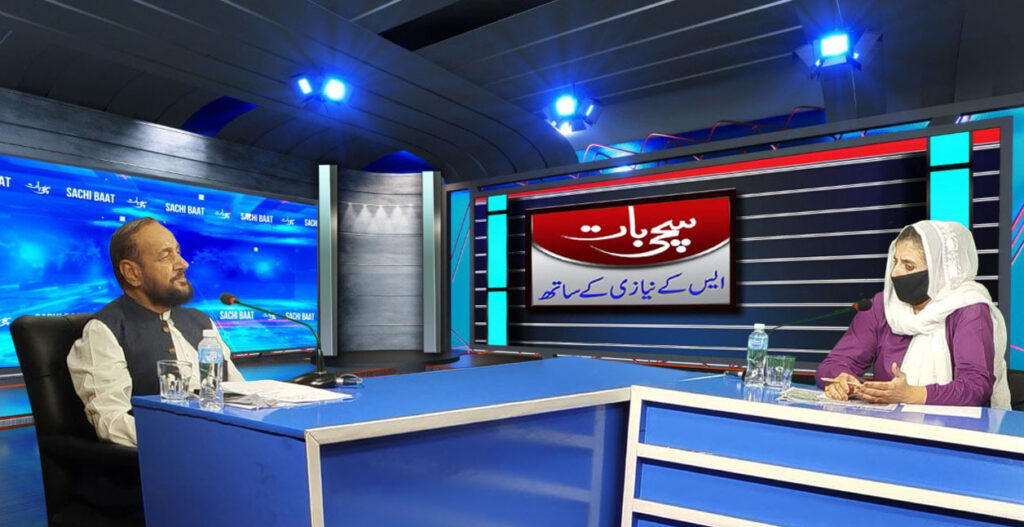
Experts discuss emergency measures, law and order, political negotiations, terrorism, economic difficulties and the formation of new provinces.
By Staff Reporter
ISLAMABAD: Editor-in-Chief Pakistan Group of Newspapers and Chairman Roze News SK Niazi, while talking in his renowned talk show Sachi Baat, said emergency was being imposed in Khyber Pakhtunkhwa, the province would improve now, and terrorism would end. Bilawal Bhutto was very happy with Governor’s rule. Provinces should be formed, and there was a great need for provinces. The decision to end emergency was conditional on improvement in the situation, and emergency might end when the situation improved. The situation in Balochistan was also not good.
Former President Supreme Court Bar Amanullah Kanrani congratulated SK Niazi on his success and extended his best wishes. He expressed the hope that Allah Almighty would grant the ability to perform all Sunnahs and duties. The issue of corruption in Balochistan, public hardship and unresolved problems was highlighted. Concern was expressed over rising casualties, the discovery of ten bodies in four to five days, attacks on labourers and martyrdom of security personnel. It was stressed that protecting lives and property, addressing economic difficulties and ensuring accountability were essential. Emergency was not a quick solution, and transparent elections should be held if the government failed to control the situation.
The first phase of an emergency-related administrative experiment had begun in 12 districts of Khyber Pakhtunkhwa. Questions were raised about the new system’s powers, accountability and separation from the provincial government. The experiment’s possible expansion across Pakistan within six months and its implications for the democratic and parliamentary system were also discussed.
Pakistan’s political history was cited to highlight repeated emergency measures, dissolution of assemblies and lack of continuity in policies. Concerns were expressed over the failure of the democratic system to deliver relief, corruption and administrative weaknesses. It was stressed that the entire system needed reforms through constitutional and legal means to ensure stability and progress.
MNA JUI-F Naeema Kishore said negotiations between the government and the opposition had been taking place seriously, but later some frivolous matters arose, preventing the process from being completed. The decision was not known, so there should be no speculation. Serious people and representatives of all parties had participated in the negotiations, which continued with the government and allied parties. The arrival of Maulana Fazlur Rehman helped advance the negotiation process. The Prime Minister met him and discussed political matters, while hopes remained for progress in talks with PTI. It was stressed that negotiations on issues such as emergency and the governor’s appointment should proceed constructively, while the final outcome required verification.
Public opinion should be considered before making administrative changes in Khyber Pakhtunkhwa. Promises made at the time of integration regarding development and public welfare remained important, while concerns were raised over NFC fund distribution and the utilisation of provincial resources.
The six-month emergency and a review after two months were discussed. The government was urged to reduce inflation, address unemployment and strengthen the economy so that the benefits of Pakistan’s international recognition could reach ordinary citizens.
PML-N was said to have assumed responsibility for Khyber Pakhtunkhwa’s longstanding problems, particularly in education and health. It was argued that political dialogue would have been preferable to the current approach, and the provincial government’s performance would be assessed after six months.
MNA Muslim League-N Ghazala Anjum said things had not improved in Khyber Pakhtunkhwa during the last 13 years. PTI rallies in favour of the rallies reflected the public situation. The party had given her the opportunity to represent the people, and she was happy about it. Making things better for the people was the priority. Concerns were expressed over allegations that Afghan soil was being used for terrorism against Pakistan and the deteriorating law and order situation in Khyber Pakhtunkhwa. The government was urged to take action against terrorist elements while distinguishing them from Afghan refugees. Joint decisions on refugee repatriation and effective counterterrorism measures were also emphasised.
Governor Faisal Karim was praised for his efforts to improve the situation in Khyber Pakhtunkhwa. It was expressed that law and order could improve through effective measures, while the six-month emergency period would provide time to address security challenges.
Difficulties faced by residents of remote areas such as Chitral were highlighted, with travel to Peshawar taking eight to nine hours and costing up to Rs. 70,000. The creation of new provinces was proposed to improve administration and public access to services, subject to constitutional procedures, parliamentary legislation and political consensus.
Government performance was linked to public relief and the resolution of people’s problems. The reconstruction of the memorial wall bearing the names of martyrs was also urged to honour their sacrifices, while Pakistan’s defence achievements under the Field Marshal’s leadership were praised.
Ghazala Anjum criticised PTI’s social media content concerning state institutions and raised concerns over protests, law and order, and the provincial government’s response. She said the federal government had shown seriousness in negotiations, while questioning the opposition’s commitment to dialogue. She also stressed the need for political consensus on legislation and effective measures to protect citizens across Khyber Pakhtunkhwa.