H.E. Dr. Rashad Mohammed Al-Alimi, Chairman of the Presidential Leadership Council, affirmed in his address marking the 64th anniversary of the 26 September Revolution that Yemen’s national struggle is fundamentally a struggle to preserve the state, the republican system, national identity, equal citizenship, and the rule of law in the face of the Houthi militias’ coup project.
His Excellency stressed that the Houthi militias have not only seized control of state institutions, but have systematically sought to dismantle them, prolong the suffering of Yemenis, undermine the national economy and public services, displace civilians, recruit young people into successive wars, and impose a system based on force, repression, discrimination, and the denial of equal citizenship.
The Chairman warned that the Houthi threat is no longer confined to Yemen. Their continued use of Yemeni territory and coastline as launching points for hostile operations has transformed the Red Sea and Bab Al-Mandab into a theatre of threats to regional and international security. Their attacks on maritime navigation and commercial shipping pose a direct danger to one of the world’s most vital international waterways and to the movement of global trade, energy, and essential supplies.
He emphasized that Bab Al-Mandab and the Red Sea must not be turned into instruments of coercion, blackmail, or the projection of power by force. The continued militarization of Yemen’s coastline and the targeting of maritime routes by the Houthi militias threaten not only Yemen and neighboring countries, but also international shipping, commercial interests, and the stability of global supply chains.
H.E. stressed that the security of Yemen is inseparable from the security of the Red Sea and Bab Al-Mandab, and that the protection of these vital waterways ultimately requires restoring the Yemeni state’s sovereignty over its territory, coastline, ports, and territorial waters. The continued Houthi control of parts of the country and their use of Yemeni territory as a platform for military escalation therefore constitute a broader regional and international security challenge.
The Chairman reaffirmed that the Yemeni state will continue to protect its citizens, national interests, and sovereignty, while its armed forces and security institutions remain committed to the protection of civilians and respect for the law. He stressed that the ultimate objective is to restore state institutions and extend legitimate state authority throughout Yemen, end the coup, and create the foundations for a genuine and sustainable peace.
At the same time, H.E. made clear that Yemenis living under Houthi control are not the enemy and must not be treated as parties to the militias’ project. He reaffirmed the state’s readiness to facilitate a safe return to the ranks of the Republic and constitutional legitimacy, with amnesty in accordance with the law for those who abandon the militias and cease their participation in hostilities.
The Chairman also expressed appreciation for the support of the Kingdom of Saudi Arabia and called upon brotherly and friendly countries to support the Yemeni government in confronting threats to Yemen’s state and institutions, as well as to the security of the region and international waterways.
The Houthi militias’ project is not merely a domestic threat. Its consequences extend from Yemen’s territory and coastline to the Red Sea, Bab Al-Mandab, international navigation, and global trade. Restoring the Yemeni state and its sovereignty is therefore essential to protecting Yemenis, securing its vital waterways, and creating the conditions for lasting regional stability and peace.
Presidential Leadership Council Chairman: Houthi Militias’ Coup Project Threatens Yemen, the Red Sea and International Navigation
Published: September 29, 2026


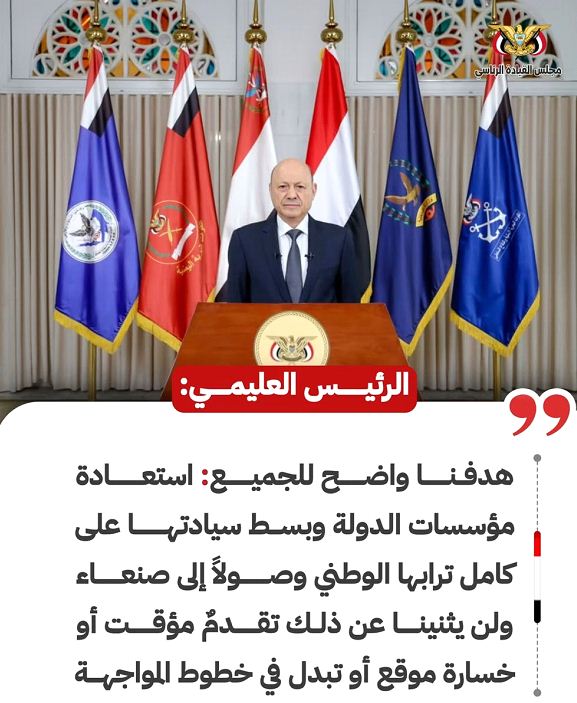
H.E. Dr. Rashad Mohammed Al-Alimi, Chairman of the Presidential Leadership Council, affirmed in his address marking the 64th anniversary of the 26 September Revolution that Yemen’s national struggle is fundamentally a struggle to preserve the state, the republican system, national identity, equal citizenship, and the rule of law in the face of the Houthi militias’ coup project.
His Excellency stressed that the Houthi militias have not only seized control of state institutions, but have systematically sought to dismantle them, prolong the suffering of Yemenis, undermine the national economy and public services, displace civilians, recruit young people into successive wars, and impose a system based on force, repression, discrimination, and the denial of equal citizenship.
The Chairman warned that the Houthi threat is no longer confined to Yemen. Their continued use of Yemeni territory and coastline as launching points for hostile operations has transformed the Red Sea and Bab Al-Mandab into a theatre of threats to regional and international security. Their attacks on maritime navigation and commercial shipping pose a direct danger to one of the world’s most vital international waterways and to the movement of global trade, energy, and essential supplies.
He emphasized that Bab Al-Mandab and the Red Sea must not be turned into instruments of coercion, blackmail, or the projection of power by force. The continued militarization of Yemen’s coastline and the targeting of maritime routes by the Houthi militias threaten not only Yemen and neighboring countries, but also international shipping, commercial interests, and the stability of global supply chains.
H.E. stressed that the security of Yemen is inseparable from the security of the Red Sea and Bab Al-Mandab, and that the protection of these vital waterways ultimately requires restoring the Yemeni state’s sovereignty over its territory, coastline, ports, and territorial waters. The continued Houthi control of parts of the country and their use of Yemeni territory as a platform for military escalation therefore constitute a broader regional and international security challenge.
The Chairman reaffirmed that the Yemeni state will continue to protect its citizens, national interests, and sovereignty, while its armed forces and security institutions remain committed to the protection of civilians and respect for the law. He stressed that the ultimate objective is to restore state institutions and extend legitimate state authority throughout Yemen, end the coup, and create the foundations for a genuine and sustainable peace.
At the same time, H.E. made clear that Yemenis living under Houthi control are not the enemy and must not be treated as parties to the militias’ project. He reaffirmed the state’s readiness to facilitate a safe return to the ranks of the Republic and constitutional legitimacy, with amnesty in accordance with the law for those who abandon the militias and cease their participation in hostilities.
The Chairman also expressed appreciation for the support of the Kingdom of Saudi Arabia and called upon brotherly and friendly countries to support the Yemeni government in confronting threats to Yemen’s state and institutions, as well as to the security of the region and international waterways.
The Houthi militias’ project is not merely a domestic threat. Its consequences extend from Yemen’s territory and coastline to the Red Sea, Bab Al-Mandab, international navigation, and global trade. Restoring the Yemeni state and its sovereignty is therefore essential to protecting Yemenis, securing its vital waterways, and creating the conditions for lasting regional stability and peace.