


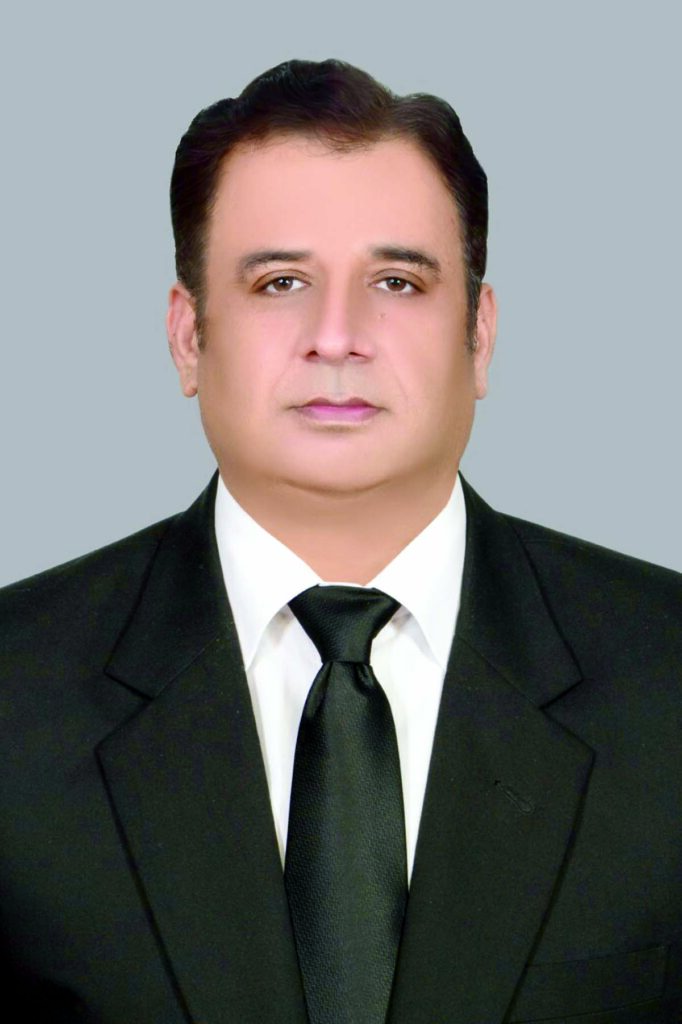
Asif Mahmood
There is sometimes a curious gap between what politicians preach and what their own political record or party manifesto says. Mahmood Khan Achakzai provides an interesting example. He currently heads Tehreek Tahaffuz-e-Aain Pakistan, a platform that presents itself as a defender of the Constitution and its supremacy. Mr Achakzai frequently speaks about constitutionalism and the need to protect the Constitution of Pakistan.
That makes it reasonable to look beyond the speeches and examine the political position of the man who heads this movement, as well as the manifesto of his own party, Pashtunkhwa Milli Awami Party. What does that manifesto say about Pakistan, its identity, its territory and its constitutional order? And how comfortably do those positions sit with the constitutional principles that Mr Achakzai invokes so frequently?
Article 5 of the Constitution of Pakistan states that loyalty to the State is the basic duty of every citizen. There is no reason to question Mr Achakzai’s personal loyalty to Pakistan. But when one reads his party’s manifesto closely, some questions inevitably arise. They deserve to be asked rather than simply brushed aside.
From the very beginning, the centre of its affection and emotional attachment is Afghanistan. Pakistan is mentioned, but only briefly and in largely negative terms. Nationalist politicians often tie themselves in knots over what they call the “Study of Pakistan”, yet the manifesto of this party, formed in 1989, begins with the “Study of Afghanistan”.
It tells us that certain areas of present-day Pakistan were actually part of Afghanistan. It then describes the atrocities committed by the British. But while discussing that colonial period, Pakistan is also mentioned in the same context, as if Pakistan too were simply a continuation of that colonial era and nothing more. In their view, even after the creation of Pakistan, nothing really changed for them.
It should be remembered that this is not an allegation. These are words contained in the manifesto of their own party.
A movement for the protection of the Constitution of Pakistan is, of course, welcome. But why does the party manifesto not reflect the same attachment to Pakistan that is now supposedly being displayed towards the Constitution of Pakistan? Is the real story really about the protection of the Constitution?
The irony is hard to miss. Whenever the nation celebrates August 14, Mr Achakzai comes forward to tell us that we were already something else on August 13, and something else before that. There is great affection and emotional attachment when Afghanistan is discussed, but a general coldness when Pakistan is concerned.
To this day, he has not been able to say a word of appreciation for the founder of Pakistan or for Allama Iqbal. What exactly is the matter?
And a word of appreciation is not even the issue. His party’s manifesto goes much further. It says that after the oppressive rule of the British, Pakistan was created and its new rulers adopted the same policy of oppression.
In other words, even Quaid-e-Azam finds no refuge in this narrative. With remarkable subtlety, the manifesto places Quaid-e-Azam and Pakistan in the same camp as the British colonial system.
Article 256 of the Constitution of Pakistan expressly prohibits the formation of a private organisation capable of functioning as a military organisation. Yet the head of Tehreek Tahaffuz-e-Aain Pakistan, while addressing a gathering at Government Model High School, Chaman, recently said: “You will give one person from every household, and we will build our national army.”
Can the head of Tehreek Tahaffuz-e-Aain Pakistan be asked why, when Pakistan already has a national army, he wants to create another army of his own? And does such a proposal not raise an obvious constitutional question?
Consider the irony. In a modern nation-state that already has its own national army, Mr Achakzai wants to raise a force on the basis of ethnic nationalism and calls it a “national army”. What kind of concept of nationhood is this? And what kind of concept of citizenship?
His grievances against Pakistan appear to run so deep that he describes Pakistan’s regular army as an army of four districts. Yet he wants to take one young man from every household in Chaman and build something of his own, giving it the name “national army”.
And despite all this, his insistence remains that the organisation he is leading is a movement for the protection of the Constitution of Pakistan.
The manifesto of his party contains an equally troubling assertion about Punjab: “the oppression and tyranny of Punjab.”
One might ask: what oppression and tyranny has Punjab actually inflicted upon you? When the opportunity arises, you can join hands with Punjabi Nawaz Sharif and secure a governorship for your brother, yet at the public level you continue to spread hostility against Punjab.
There is another interesting problem with this argument. The manifesto places the responsibility for One Unit at Punjab’s door and then cites it as evidence of Punjab’s oppression and tyranny.
That is factually incorrect.
When One Unit was introduced, the prime minister was Muhammad Ali Bogra. Was he from Punjab? No. He was from Bengal. The Governor-General at the time was Iskander Mirza. He was not Punjabi either; he was Bengali.
That Bengali prime minister had appointed Ayub Khan as his defence minister. And Ayub Khan too was not from Punjab. He belonged to a Pashtun family from Khyber Pakhtunkhwa. He was not Punjabi either.
Someone should tell the head of this supposed movement for the protection of the Constitution that if insulting Punjab is so essential, at least get the sequence of historical events right.
The sanctity of the Pakistan-Afghanistan border also appears to have little place in the manifesto of Mr Achakzai’s party. Much has been written between the lines, revealing where the emotional attachment lies, while much more has been stated explicitly.
So can the head of Tehreek Tahaffuz-e-Aain Pakistan be asked where, exactly, the Constitution provides for opening the Afghan border for free movement? Why does the psychological knot surrounding the Durand Line remain so firmly tied?
There is another revealing detail that makes their thinking even clearer.
The manifesto does not simply demand that the border between Afghanistan and Pakistan be opened and free movement be allowed. Instead, it says that such an arrangement should be made between Pashtunkhwa and Afghanistan.
This is a very subtle and profound point. It needs to be understood.
They should be asked: the Constitution of Pakistan clearly defines Pakistan’s territory and its borders. Do you accept these borders of Pakistan? Why is your fixation with the Durand Line so intense? Are you not, in effect, standing in a direction contrary to the geographical integrity and security of Pakistan?
The problem in our country is that the process of appeasing nationalist leaders seems to have no end. They are allowed to say almost anything. God forbid anyone should disagree with them.
They may spread provincial hatred or deliver lofty pronouncements, yet nobody seems willing to turn around and question them.
Otherwise, the reality is right in front of us.
Put this manifesto on the scales of the Constitution and the law, and then ask the Election Commission a straightforward question: can a political party holding such views, as a matter of law, be eligible to contest elections in Pakistan?