


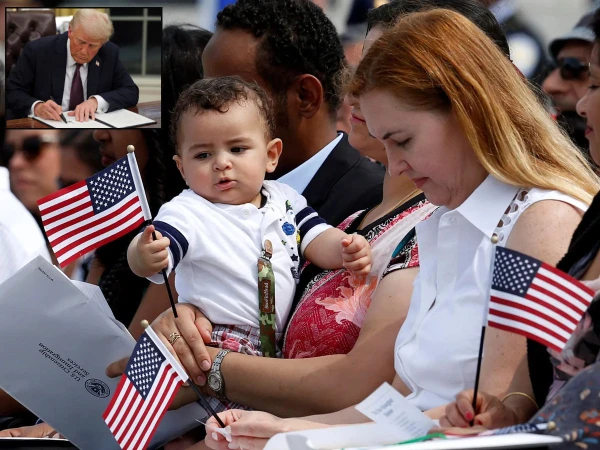
President Donald Trump has issued two new executive orders seeking to limit the right to birthright citizenship for children born in the United States.
According to the World News Agency, President Trump’s move comes a few weeks after the US Supreme Court rejected his previous attempt and ruled to retain birthright citizenship under the Constitution. ExecutiveBranch
Signing two executive orders at the White House, President Trump said that this should have been done years ago, but now we are making sure it happens.
President Donald Trump called the Supreme Court’s decision unfair and said that his administration will pursue the matter through a different legal path.
The first executive order further expands the scope of foreign parents whose children born in the United States will not be able to receive automatic US citizenship.
If both parents of the child are not U.S. citizens and one of them is a member of a foreign terrorist organization, an employee of a foreign government, is trying to obtain U.S. citizenship through fraud, or is living in a U.S. territory where automatic citizenship is not granted under federal law.
Under the new presidential order, if any of the above is proven, a child born in the United States to such parents will not receive birth U.S. citizenship.
President Trump’s order states that some malicious foreign elements try to take advantage of U.S. laws and abuse the generosity of the United States. ExecutiveBranch
Ban on birth tourism
The second presidential order is against birth tourism. This term refers to the process in which pregnant women come to the United States on tourist or visitor visas so that their children are born in the United States and automatically receive U.S. citizenship.
President Trump claimed that millions of children become American citizens through this method every year, but according to the Migration Policy Institute, an independent research organization, it is estimated based on the census that approximately 22,000 to 26,000 children are born in the United States annually through birth tourism.
On the other hand, according to US government data, in 2024, 9,600 children were born in the United States to foreign mothers.
Stephen Miller, the President’s Advisor for Homeland Security and Deputy Chief of Staff of the White House, said that some people come to the United States as tourists or visitors, but their real goal is to get the child American citizenship.
According to him, such children later benefit from various government facilities, voting rights and other legal privileges based on American citizenship.
Stephen Miller said that the Immigration and Nationality Act gives the president the authority to impose restrictions or conditions on entry into the country under certain circumstances, and birth tourism is being stopped under this authority.
The Supreme Court had rejected Trump’s previous presidential order
It should be remembered that immediately after taking office in January 2025, President Trump tried to eliminate the right to birthright citizenship under the 14th Amendment to the US Constitution through a presidential order.
Several states and civil rights organizations appealed this decision to the court, after which the case reached the Supreme Court.
The US Supreme Court ruled in June 2026 that Trump’s previous policy was inconsistent with the Constitution and birthright citizenship will continue to be in effect in the United States.
What do legal experts say?
Davis School of Law professor Gabriel Chen said that the president may have the authority to impose some restrictions on entry into the United States to stop birth tourism, but once a child is born in the United States, no one has the authority to deprive him of American citizenship.
He added that the Supreme Court has already given a clear decision on this issue, so some parts of the new orders can be challenged again in the courts.
Prominent American legal experts also say that Trump’s new policy will also undergo constitutional and legal scrutiny and it is likely that a new court battle will begin against it.