


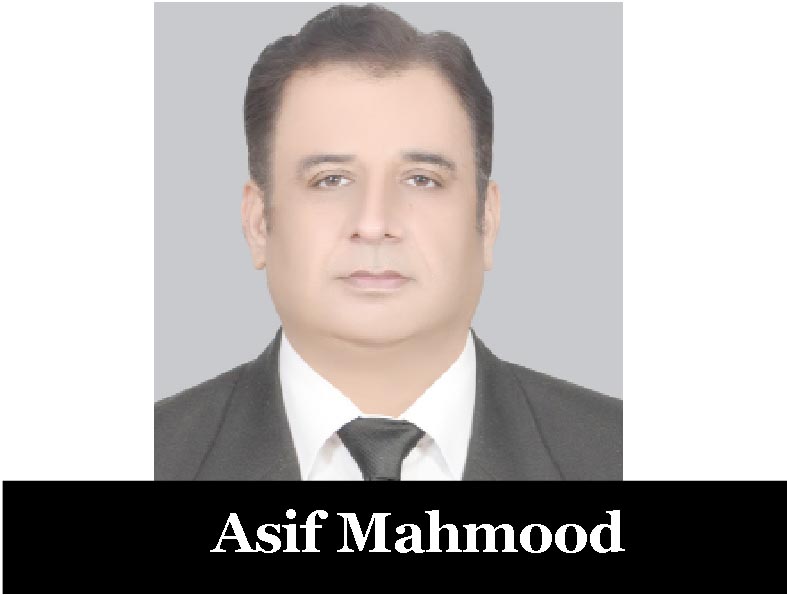
Asif Mahmood
Small administrative units are essential for Pakistan. Those who criticize the idea of smaller administrative units should ask themselves whether their commitment to democracy extends beyond mere slogans. Small administrative units are, in fact, a means of empowering people at the grassroots level. Only those who have kept society under their grip in the name of democracy, and who are unwilling to think beyond their familial, group, and financial interests, can oppose this idea.
If we look at the constitutional scheme, the Constitution provides not only for elections to the National Assembly and the Provincial Assemblies but also for local government elections. The issue is that if elections to the National Assembly or the Provincial Assemblies are postponed for some time, are not held on schedule, or are delayed, there is an uproar that the Constitution is being violated. But the Constitution also provides for local government elections. So why is it that, despite the absence of local elections, no political party raises the same outcry that the Constitution is being undermined?
What kind of commitment to constitutional supremacy is this, when it is confined only to elections for the National Assembly and the Provincial Assemblies? The obvious reason is that political parties conduct their affairs through these assemblies. No Member of the National Assembly or Member of the Provincial Assembly wants the people of his constituency to become free from his control. That is why most political parties support the local government system only in words, not in practice. A strong local government system empowers people at the grassroots level. And when people become empowered and autonomous at that level, the influence of Members of the Provincial Assembly and Members of the National Assembly is inevitably weakened.
In the name of democracy, these people have, in reality, kept society under their control. Development funds can only be distributed fairly through administrative units. This is not democracy.
Democracy, in its true sense, means that powers and resources are devolved to the grassroots so that people have a genuine sense of participation in governance. Unfortunately, that has not happened in our country. Power remains concentrated in the hands of a few. Cabinets are largely drawn from a handful of districts. Even the women elected on reserved seats generally come from a few influential families in a few districts. Smaller towns are often neglected, while the distribution of funds is tilted in favour of larger cities.
Development funds should be allocated to districts as soon as they are released to the provinces. The people of each district should then be asked: these are your funds; you should decide where they are to be spent. There is no need for an MPA to stand in between.
One possible model is to have the federation at the top and district governments below. Another possibility is to create new provinces. However, if new provinces are not to be established, then the utility of the provincial assemblies, in any case, is not particularly significant. This option also deserves consideration: a federation at the top and district governments below. It is essential that both resources and authority reach the people at the grassroots level.