


By Nawabzada Shah Ali
In international relations, some partnerships develop quietly, away from the spotlight, yet gradually evolve into relationships of significant strategic importance. The ties between Pakistan and the Philippines represent one such success story. Despite the geographical distance separating South Asia and Southeast Asia, the two nations have cultivated a relationship based on mutual respect, trust, and shared interests for more than seven decades. Today, that relationship is entering a promising new phase.
Diplomatic relations between Pakistan and the Philippines were formally established in 1949. Since then, both countries have maintained cordial engagement on bilateral, regional, and international platforms. However, recent years have witnessed a notable acceleration in cooperation, reflecting a shared determination to move beyond traditional diplomacy toward a more robust economic, commercial, and people-to-people partnership.
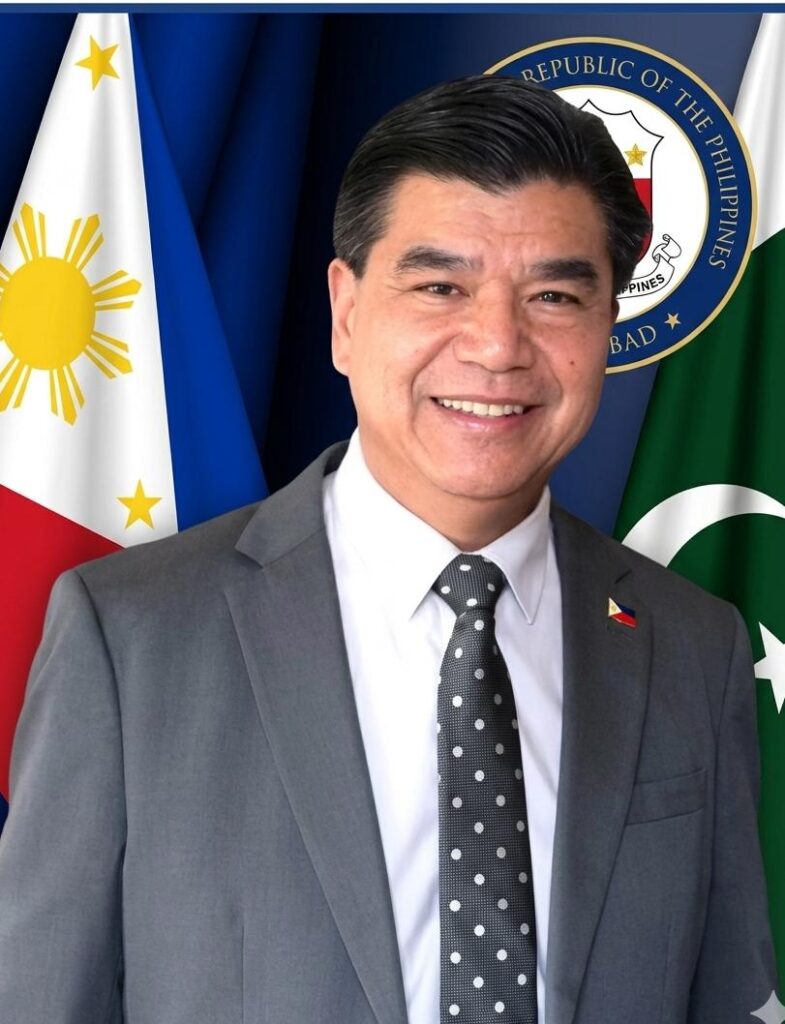
A key figure in this positive trajectory has been Ambassador Dr. Emmanuel R. Fernandez of the Philippines. Widely recognized for his proactive and forward-looking approach, Ambassador Fernandez has emerged as an important catalyst in strengthening bilateral relations. Through his energetic diplomatic engagement, he has helped expand cooperation beyond government circles, fostering stronger connections among business leaders, academics, media professionals, and cultural institutions in both countries.
One of the most significant developments in 2026 was the convening of the Second Session of the Pakistan–Philippines Joint Economic Commission (JEC). The meeting resulted in renewed commitments to enhance cooperation across a broad spectrum of sectors, including trade, investment, agriculture, education, healthcare, energy, tourism, and the rapidly growing halal industry. Equally important was the decision to explore the possibility of a Preferential Trade Agreement (PTA), which has the potential to substantially increase bilateral trade and create new economic opportunities for businesses in both nations.
For Pakistan, the Philippines is more than a friendly country; it is one of Southeast Asia’s fastest-growing economies and a key member of ASEAN. Conversely, Pakistan represents a strategically important market in South Asia, offering access to a population of over 240 million people and serving as a gateway to regional connectivity initiatives. Enhanced cooperation between Islamabad and Manila therefore carries significance not only for bilateral relations but also for strengthening Pakistan’s engagement with the broader ASEAN region.
Recent efforts to expand Pakistan’s rice exports to the Philippines further highlight the growing economic dimension of the relationship. The Philippines remains an important market for Pakistani agricultural products, and both governments have expressed interest in expanding cooperation in food security and agribusiness. Beyond agriculture, new opportunities are emerging in pharmaceuticals, healthcare, information technology, digital innovation, and artificial intelligence—sectors that are expected to drive future economic growth in both countries.
Ambassador Fernandez’s diplomatic style deserves particular recognition. Rather than limiting his efforts to official meetings and ceremonial engagements, he has actively reached out to chambers of commerce, universities, think tanks, and media organizations. This approach reflects the realities of modern diplomacy, where sustainable international partnerships are built not only between governments but also through strong institutional and societal linkages.
Pakistan’s foreign policy has traditionally focused on major powers and immediate regional concerns. However, the changing global economic landscape underscores the importance of expanding partnerships with emerging economies and dynamic regional actors. In this context, the growing relationship with the Philippines represents a timely and strategically valuable development.
At the same time, it is important to acknowledge that bilateral trade and investment levels remain well below their true potential. Greater collaboration between private sectors, trade organizations, educational institutions, and innovation ecosystems could unlock substantial opportunities in the years ahead. With the right policy support and sustained diplomatic engagement, the partnership can reach unprecedented levels of cooperation.
The contributions of Ambassador Dr. Emmanuel R. Fernandez have provided fresh momentum to this journey. His efforts demonstrate that Pakistan–Philippines relations are evolving beyond formal diplomatic exchanges into a comprehensive partnership founded on mutual respect, shared prosperity, and a common vision for the future.
As the world adapts to new economic realities and shifting geopolitical dynamics, the relationship between Pakistan and the Philippines offers an encouraging example of how nations can overcome geographical distance through strategic vision, continuous engagement, and effective leadership. It is a partnership with considerable promise one that has the potential to contribute not only to the prosperity of both countries but also to greater regional connectivity and cooperation across Asia.