


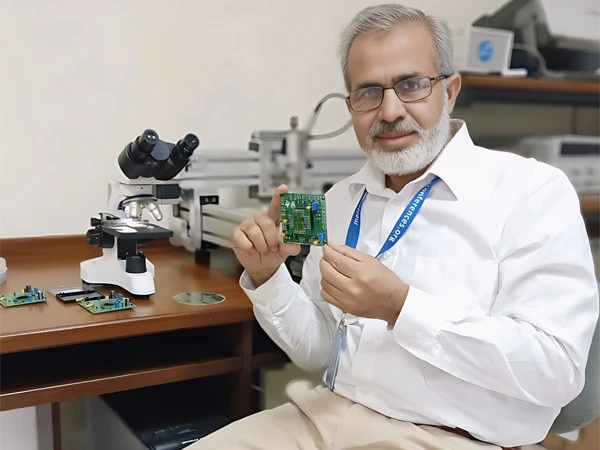
From smartphones to satellites and from cars to planes, the heart and soul of every invention lies in a tiny microchip, which is also an important aspect of the global technology horizon and economy.
This year, we saw the world’s major powers from China to the United States battling over electronic chips and rare earths. Then, for the first time in history, we saw the assets of Nvidia reaching four trillion dollars, which does not actually manufacture a single microchip but only does research and design work. Then, some of the world’s famous foundries manufacture millions of microchips on the same design. A foundry requires abundant rare earths, expertise, specialized laboratories, electricity and abundant water, which is a recipe for millions of dollars.
Nvidia’s concept of ‘fabless’ (zero manufacturing) could be a practical way to design microprocessors for Pakistan.
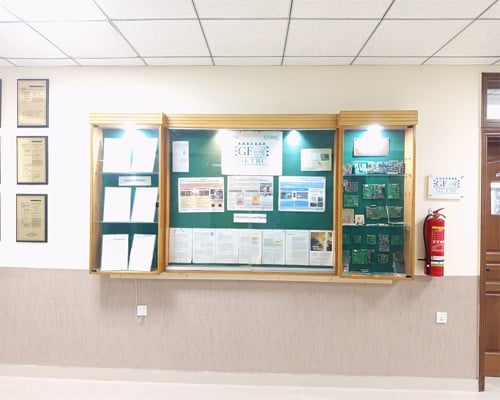
The display in the corridor of the IC Lab features prominent research posters and prototypes that are the efforts of this organization. Image courtesy of Fast University
Research posters and prototypes displayed in the corridor of the IC Lab, the efforts of this institution. Image courtesy of Fast University
To find out more, Express visited the Fast National University for Computer and Emerging Sciences (Fast NUCS). Here, the Integrated Circuit Design (ICD) Lab not only conducts research on microchips but also provides education and training to young engineers.
Starting from a room
Walking through the bright hallway of Fast University, you will see research posters and microprocessor prototypes on the walls, the efforts of Dr. Rashid Ramzan and his team. But it started with just one room, which has now become a large laboratory.
After graduating from the University of Engineering and Technology, Lahore, Dr. Rashid Ramzan started chip designing at the VLSI Lab of Ohio State University, USA. He did his Masters in Electronics Engineering from the Royal Institute of Technology, Stockholm in 2003.
His next academic stop was Linköping University in Sweden, where he completed his doctorate. Dr. Rashid Ramadan has 25 years of experience in chip design in industries and universities in the United Arab Emirates, Sweden, Germany, the United States, and Pakistan.
In 2018, he joined the Fast University for Computer and New Emerging Sciences. Here, with a small room and ten master’s students, he began teaching microelectronics, RF circuits, electromagnetics, and PCB design.
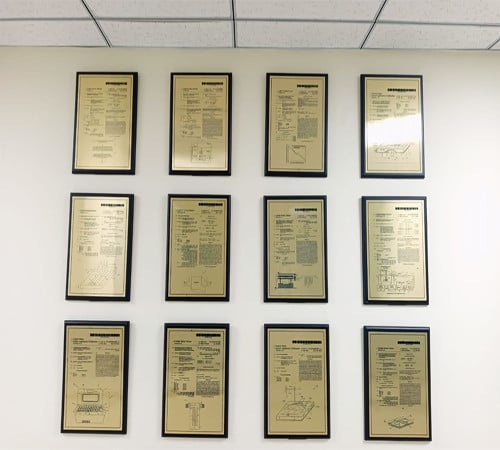
Metal signboards in Dr. Rashid Ramadan’s laboratory that display the history of international inventions and patents. Photo courtesy of Fast University
Metal signboards in Dr. Rashid Ramadan’s laboratory that display the history of international inventions and patents. Photo courtesy of Fast University
“In 2018, we practically had only one room, which was an office and a laboratory. Despite this, I was absolutely convinced that if we wanted to succeed, we had to adopt this technology. Now, by the grace of God, new doors are opening for us,” Dr. Rashid told Express.
Fast University was also the dream of a visionary banker, Agha Hassan Abidi. He founded it with an amount of Rs. 100 million in the 80s. The journey of IC designing at Fast continued in the same way, however, each new day is increasing the importance of semiconductor and IC technology.
Pakistan and the Fabless Strategy
The question is, is the complete manufacture (fabrication or fab) of a computer chip possible in Pakistan?
“This is a very difficult task for many reasons, as it requires a lot of advanced technology on a commercial scale, as well as uninterrupted power supply 24 hours a day, 365 days a year, specialized infrastructure and vast amounts of clean water,” Dr. Rashid said.
“Technically, billions of dollars of advanced equipment are required, including advanced photolithography machines, etching and ion implantation setups. These machines require clean rooms and complex vacuum environments. Then, a team of specialized engineers and technicians from about 60 different disciplines, working step by step, is required to operate these equipment. These include civil, mechanical, electrical, chemical, optical and vacuum technology, to name a few,” Dr. Rashid said.
Then, this work can only be possible with a continuous and uninterrupted supply of rare earths, precious metals, chemical components and countless other items for the production of these chips.
‘There is fierce competition in the global market, which is a major obstacle in the sale of our products. Big companies are already there with their reputations and in this situation, it will be a challenge for a new company to make a place. In this context, research and design on chip manufacturing is the most beneficial path for Pakistan,” Dr. Rashid told Express.
That is why the commercial microchips industry is dominated by a few big players, which are beyond the reach of Pakistan. The most important name among them is Taiwan Semiconductor Manufacturing Company (TSMC), which has a 70% market share. This company manufactures chips up to 3 and 5 nanometers for major companies like Apple, Nvidia and AMD.
In contrast, the famous Nvidia company does not make a single chip and has been making graphic processing units (GPUs) based on its knowledge and is now designing the latest AI processors. Focusing only on research and design, TSMC makes thousands, millions of chips.
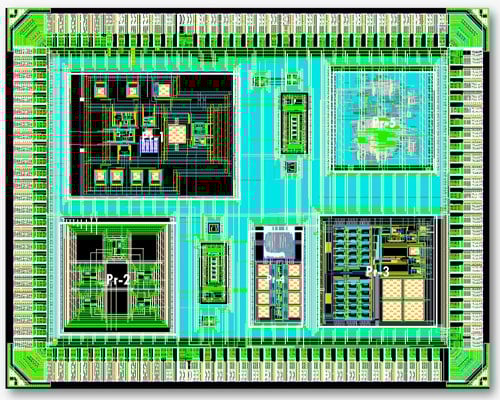
Dr. Rashid founded it in 2009 but did not succeed, then he did something Microchip designed after research at FAST, Chip Designing Lab. Image courtesy of FAST University
“Just as you cannot become a surgeon by reading surgical books, similarly, the theory of chip design is insufficient, so it is necessary to get practical training from an expert,” he said.
Pakistan, on the international stage
In 2021, the International Solid State Circuits Society (SSCS) launched an annual IC design competition called Platform for Design Outreach (PICO). FAST IC Lab has participated in its competitions every year and has so far won 17 out of 44 awards and honors, which is 30 percent of the total prizes. The remaining award winners include the United States, France, South Korea, Egypt, Brazil and other countries.
Thanks to these outstanding achievements, the laboratory has successfully appeared on the global horizon and also represented Pakistan.
Omani Engineers and GSME
Years of hard work and academic toil paid off when the American company Global Semiconductor Microelectronics (GSME) approached Fast University for its new design center in Oman. Here too, the lab competed with major international companies and institutions, and Fast University eventually won the contract. Under the training program, 100 Omani engineers were provided with classroom training, theory, and practical training in microchip design from start to finish. These chips were manufactured by TSMC and finally tested. It should be noted that all these academic and practical stages are very important for any IC designer!
All students were made to strict standards in the training. Lectures were held in the morning and labs were held in the afternoon. As a result of this discipline, nine projects were completed after a year, including two 65-nanometer CMOS dies that were molded by TSMC. The same team went to Oman and established the country’s first chip design center, which is still operating successfully three years later.
Then, inspired by this success, GSMA agreed to provide financial support for the first chip design center in Pakistan, which is a major achievement of FAST NUCS.
“The centre, now known as GF-METRC, is fully operational and has successfully completed several projects supporting Pakistan’s industries,” said Dr. Ramzan.
Training a new generation
Initially, a training programme was started between FAST and NICOP, after which GSMA provided funds in 2023.
‘During this period, many difficulties arose and financial resources dried up to the point that there was a fear that the programme might be shut down. However, at that time, the candle of knowledge was kept burning with the financial support of our philanthropic friends, overseas Pakistanis and alumni of UET Lahore.
After this challenge, 2025 proved to be very auspicious. First, the government realized this important sector and got funding from the Ministry of Information Technology (MIOT) through the IGNITE programme. Under this, 33 engineers will be trained in IC design for one year and educated up to MS. Another short-term training programme was launched by the Pakistan Software Export Board (PSEB).
A caravan has been formed
In 2018, there was only one microchip design verification company in Pakistan, and now there are at least 18 companies in Karachi, Lahore and Islamabad. Of these, only FAST University has provided 100 I-design experts to Pakistanis. Some are also doing PhDs abroad, the rest are associated with local companies.
Shortage of manpower
Although Pakistan has started a confident journey in this sector, there are several obstacles in expanding it further and preparing the manpower.
‘If any multinational company wants to open a chip design center in Pakistan, it will require 1000 to 1500 engineers. Now, 1000 people in this field will be found in the whole of Pakistan. Vietnam is the focus of attention of IC design companies these days. So like Vietnam, we have to create a pool of 10,000 engineers so that we can invite companies like Nvidia, AMD and TI and they can select 10% of the best talent from them and open the company. We are far from even this minimum standard,” Dr. Rashid Ramzan said.
Although Pakistanis are working in executive positions in organizations like AMD and Altera abroad, attracting global companies will remain a dream until we increase our workforce at home.
Lack of Intellectual Property (IP) laws in Pakistan
Pakistan’s intellectual property (IP) laws are a major obstacle in this regard. On the other hand, there is a lack of lawyers who are familiar with the laws related to high-tech IP because the culture related to property rights has not been developed.
“The ownership of an invention or patent is worth tens of millions of rupees and in this regard we have to make strict and clear laws,” Dr. Rashid told Express.
Patents, inventions and innovations
Despite various ups and downs, Fast Lab has also secured US patents with innovative technology. These include the temperature information of vaccines. Low-cost monitoring systems, sensitive sensors for monitoring fuel tanks, 5G and 6G duplexers are just a few names. These innovations show that despite the unfavorable conditions in Pakistan, we can move forward in this field.
“If Pakistan wants to follow the path of high-tech fabless chip designing, it will have to create design centers based on the highest level of training. If